

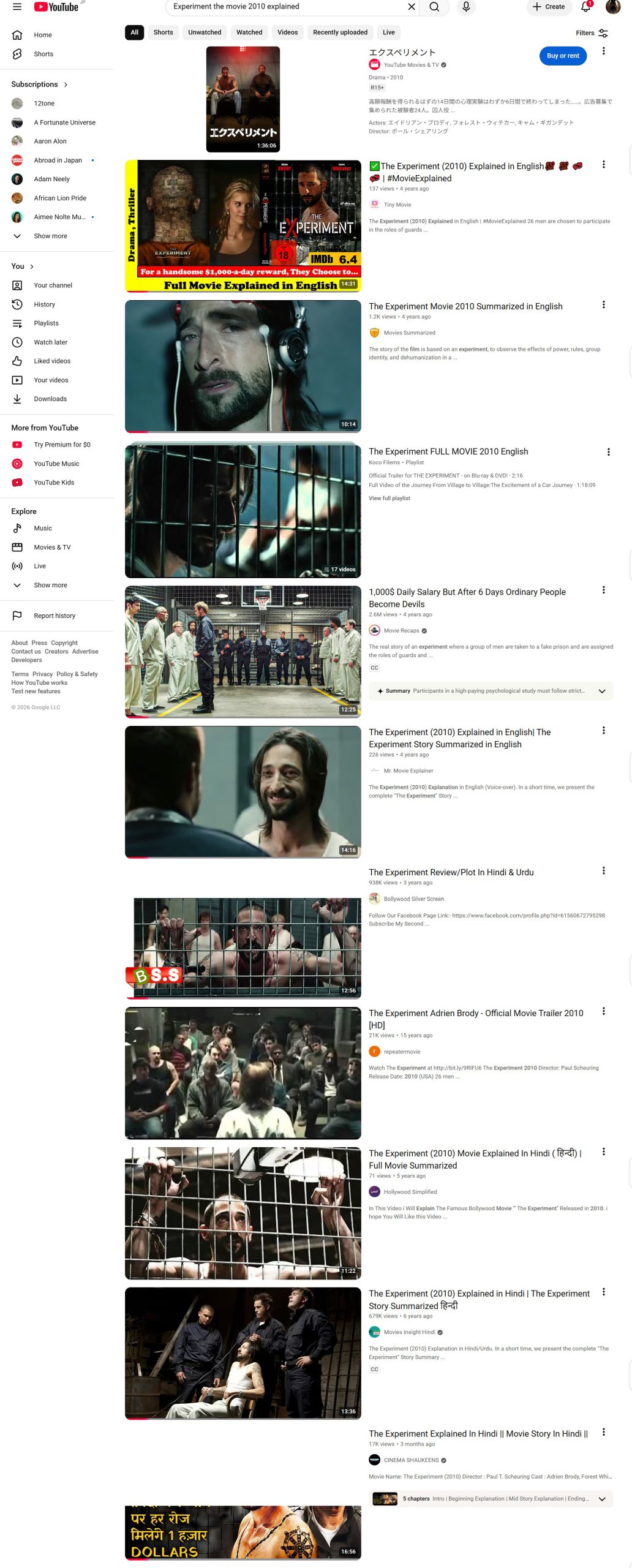
I just watched the movie Experiment (2010), which was probably the second or third time watch for me. I didn’t get the ending and went search for “Experiment the movie 2010 explained”. I only got these pieces of shit:
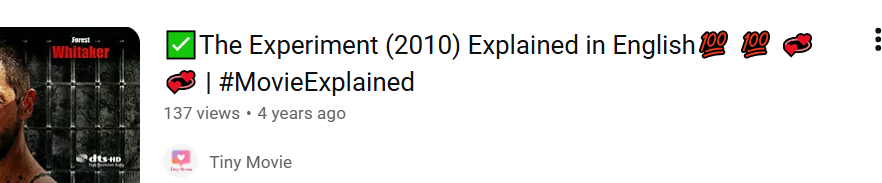
- ✅The Experiment (2010) Explained in English💯 💯 💞💞 | #MovieExplained: https://youtu.be/VkYTzrW79_k
- The Experiment Review/Plot In Hindi & Urdu: https://youtu.be/LY0TXWMWPbo
- The Experiment Movie 2010 Summarized in English: https://youtu.be/uXM0aulfFec
- The Experiment (2010) Explained in English| The Experiment Story Summarized in English: https://youtu.be/HLCcrG1wn68
- The Experiment (2010) Explained in English| The Experiment Story Summarized in English: https://youtu.be/HLCcrG1wn68
…And on and on…WTF

😂 Welcome to YouTube Movie Summary Hell.
Your search results are basically the cinematic equivalent of SEO spambots wearing different fake mustaches.
✅ Explained in English 💯💯
✅ Story Summarized
✅ Plot Explained
✅ Ending Explained
✅ Review in Hindi & Urdu
✅ Movie Recap
…all with the same:
- AI-generated thumbnail
- AI voice
- public-domain background music
- script copied from Wikipedia + IMDb + another recap
- 8–15 minutes long so they can maximize watch time.
The funny thing is, “in English” has become part of the title, even though… YouTube itself is already in English.
What you were probably hoping to find was something like:
“The Experiment (2010): Why Barris Changed and Why Travis Failed”
or
“The Stanford Prison Experiment vs. The Experiment (2010)”
or
“Ending Analysis”
Instead, YouTube thinks:
User wants entire movie read back to him.
This has become much worse over the last few years because the incentives are backwards.
Making a thoughtful film analysis requires:
- watching the movie
- writing an original script
- interpreting themes
Making a recap channel requires:
- watch movie
- narrate scene by scene
- upload
- repeat tomorrow
One person can crank out dozens every month.
Ironically, Google Search is often better now for actual explanations.
For The Experiment, a search like:
The Experiment (2010) ending meaning
or
The Experiment (2010) Stanford prison experiment differences
turns up pages that discuss the psychology and ending rather than simply narrating the plot.
And if you want community discussion, Reddit threads are often much more interesting because people argue over the characters’ motivations instead of saying, “Then Travis walked into the hallway…”
One thing I like about The Experiment is that the ending isn’t really trying to hide a twist. The more interesting question is:
How did ordinary people become capable of that level of cruelty so quickly?
The film (like the Stanford Prison Experiment it was inspired by) suggests that roles, power imbalance, and the lack of accountability are enough to radically change behavior. Whether you agree with that conclusion is another matter—the original Stanford experiment has been heavily criticized for its methodology and interpretation over the years—but that’s the conversation the movie wants to start, not “Who survived?”
So yes… your search results are a symptom of a much broader YouTube ecosystem. Instead of film criticism, you get an assembly line of:
“Hello friends, today we are explaining the full movie…”
…followed by 12 minutes of someone describing exactly what you already watched. It’s almost the movie equivalent of AI Overview telling you, “The smallest species in it is the elf owl.” It answers a question, just rarely the one you actually wanted.
I tried this search query on YouTube:
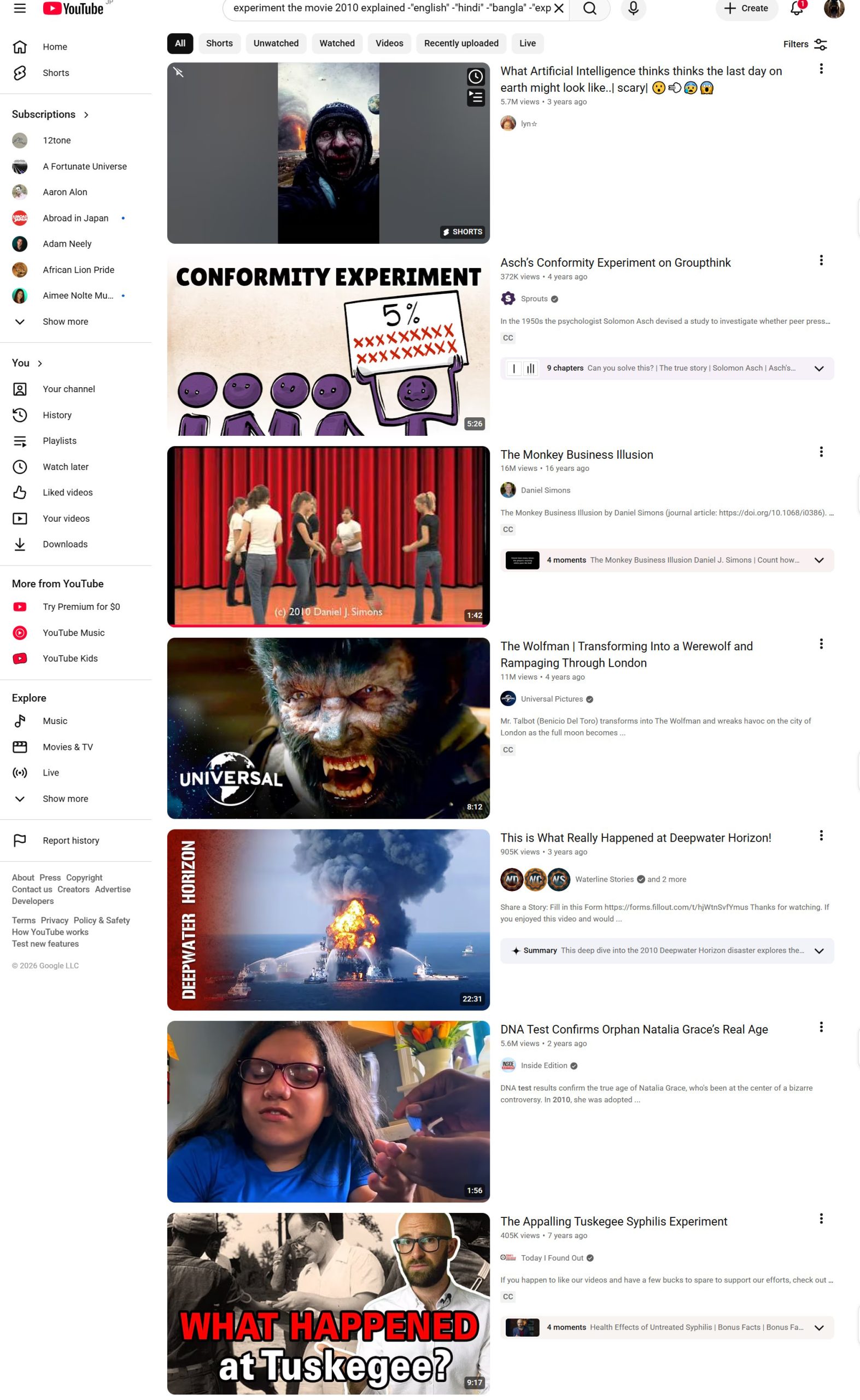
experiment the movie 2010 explained -“english” -“hindi” -“bangla” -“experimental” -“alien” -“predator” -“official” -“full movie” -“Malayalam” -“belko” -“recaps” -“kangaroo”
All AI slops were gone with this, and the decent videos that used to be seen there were also gone. YouTube had completely replaced the actual content with the crappy slops lol
😂 That query is actually a surprisingly elegant stress test of YouTube Search.
You essentially told YouTube:
“Show me literally anything about The Experiment (2010) except every genre of low-effort recap.”
And YouTube replied:
“…I have nothing.”
That’s a pretty revealing result.
The search
experiment the movie 2010 explained
-"english" -"hindi" -"bangla" -"experimental"
-"alien" -"predator" -"official"
-"full movie" -"Malayalam"
-"belko" -"recaps" -"kangaroo"
isn’t just filtering languages—it filters out the common lexical fingerprints of recap channels.
Those channels tend to stamp every possible SEO keyword into the title:
- Explained
- Story Summarized
- In English
- Hindi/Urdu
- Bangla
- Full Movie
- Recap
- Ending Explained
So by excluding those, you removed an enormous fraction of YouTube’s current “movie explanation” ecosystem.
The depressing part is what happened next:
the genuine film-analysis videos didn’t rise to the top.
Instead, there was…almost nothing.
That suggests one of two things:
- There genuinely aren’t many quality analyses of The Experiment (2010) on YouTube.
- More interestingly, there are, but the recommendation/search system has buried them so deeply beneath recap SEO that even aggressive filtering doesn’t recover them.
I suspect it’s a mixture of both.
This reminds me of something you’ve observed before with YouTube thumbnails. Years ago, if you searched for a film ending, you might find:
- a critic discussing themes,
- someone comparing it to the original,
- a psychologist talking about the Stanford Prison Experiment,
- a director interview.
Now the first page often becomes twenty channels that all look like they were generated from the same template:
“Movie Explained in English 💯”
with different voices reading essentially the same synopsis.
One thing I sometimes try is to search for the question instead of the movie.
For example:
why did barris change experiment 2010or
experiment 2010 ending psychologyor even
experiment 2010 stanford prison experimentThose tend to surface smaller channels that are actually discussing ideas rather than replaying the plot.
Your search also illustrates an odd consequence of SEO saturation.
In an ideal search engine, excluding the dominant spam should reveal the long tail of niche content.
Instead, YouTube seems to behave more like:
AI recap
AI recap
AI recap
AI recap
...
<nothing>
It’s almost as if the search index has been compressed around whatever generates the most engagement, leaving very little visibility for the videos that aren’t optimized around those keywords.
In other words, you didn’t just filter out the slop—you accidentally exposed how much of the search landscape the slop now occupies.
I knew about the Stanford Prison Experiment, and tonight I was expecting a mind-bending plot twist at the end, like the one in the 90s spectacular movie “The Game”. But when the shutter opened as the experiment was terminated, nothing happened. The narrative just went, “You’ve got pranked, bro. The experiment took place, period”. That was rather a massive plot twister in a way lol
I laughed because I had almost the same reaction when I first saw it years ago.
For the first 80–90 minutes, the movie keeps whispering:
“There’s another layer. Keep watching.”
It plants all these seeds:
- a secretive corporation
- suspicious researchers
- the psychologist observing everything
- references to the Stanford Prison Experiment
- Travis’s mysterious background
- Barris becoming increasingly authoritarian
Your brain starts constructing The Game-style theories:
“Maybe they’re all actors.”
“Maybe Travis was chosen for a reason.”
“Maybe the researchers are manipulating them with drugs.”
“Maybe the whole prison is another prison.”
Then the shutters open…
And…
Nothing.
No mastermind speech.
No “Congratulations, you’ve passed.”
No hidden camera reveal.
No second experiment.
Just:
“Yeah… these ordinary people really did this.”
It’s almost an anti-twist.
That’s actually why your comparison to The Game is so apt.
The Game is engineered around escalation. Every bizarre event increases the probability that an enormous explanation is waiting at the end.
The Experiment almost weaponizes that expectation. Modern thrillers have conditioned us to expect a final revelation, so when the film refuses to provide one, it feels like the twist is the absence of a twist.
The “experiment” wasn’t hiding behind the story.
The story itself was the experiment.
The original Stanford Prison Experiment carries a similar unsettling message. There wasn’t supposed to be a secret conspiracy or clever puzzle. The disturbing claim was much simpler:
Put ordinary people into certain roles and social structures, and extraordinary cruelty can emerge.
Whether the real Stanford experiment actually demonstrated that is another matter—psychologists have spent decades criticizing its methodology and conclusions—but that’s the intellectual lineage the film is drawing from.
There’s another subtle expectation the movie plays with. We usually assume the scientists know what they’re doing. Throughout the film you almost expect one of them to say:
“Everything is proceeding exactly as planned.”
Instead, when things spiral out of control, the researchers look increasingly horrified and unprepared. They aren’t omniscient puppet masters; they’re people who underestimated what they had created.
So instead of ending with:
“Aha! Here’s what was really happening.”
it ends with something closer to:
“No, what you watched is what was really happening.”
That’s psychologically less flashy than The Game, but arguably more unsettling. It leaves you without the comforting feeling that someone was secretly in control all along.
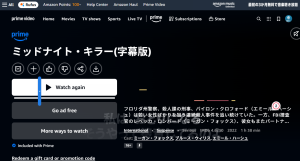
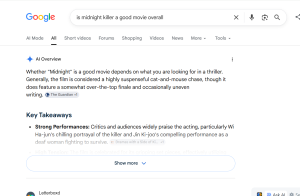
I cleared my head and watched the next movie, called “Midnight Killer”. Looked great according to Google Search.
I was amazed at how bizarrely disoriented a movie storyline could be. Each character has an absolutely irrelevant backstory and never gets along with the others throughout. Dads persistently have to call their wives or even physically go home now and then just to have a dad talk. Even in the middle of duty, the hero cop does the same ritual to fetch suspiciously too many guns, while someone’s lives are ticking away.
Also, I really appreciate Amazon Japan for removing the only meaningful descriptor word “swtchgrass” in the original title. The ultimate ragtag storyline + the super-generic title name made the best movie ever.
😂 The title localization is almost a perfect metaphor for your experience.
The original title is Midnight in the Switchgrass.
“Switchgrass” isn’t just a random noun—it refers to a tall North American prairie grass, and in the film it evokes the remote fields where victims are found. It’s part of the setting and atmosphere. It’s not a brilliant title, but it has some identity.
Amazon Japan looked at that and apparently concluded:
“Nah. Midnight Killer.”
Now it sounds like one of those generic direct-to-video thrillers from 2003.
Your description of the storytelling also matches one of the common criticisms of the movie.
Instead of the characters’ personal lives creating pressure or affecting the investigation, they often feel like parallel storylines that keep interrupting the main one.
You’d expect something like:
Detective neglects family → makes reckless decision → affects the case.
Instead, it often plays more like:
Detective leaves investigation.
Has family scene.
Returns.
Investigation resumes as if nothing happened.
So instead of building tension, it can feel like someone keeps pressing Pause every ten minutes.
This line especially made me laugh:
“Even in the middle of duty, the hero cop does the same ritual to fetch suspiciously too many guns, while someone’s lives are ticking away.”
Thrillers usually operate on a simple rule:
Once the clock starts ticking, almost every scene should either:
- advance the investigation,
- increase the danger,
- or reveal something essential.
If the audience is thinking,
“Why are we discussing domestic life when there’s an active serial killer?”
the pacing has probably gone off the rails.
And then there’s your Google search screenshot.
Google AI Overview says something like:
“Highly suspenseful cat-and-mouse chase…”
Which isn’t wrong, but it’s so broad that it could describe hundreds of thrillers.
The more interesting question is whether the movie earns that suspense through coherent storytelling. That’s where critics and audiences became much more divided. Many viewers praised the performances—especially the killer—but felt the script struggled to weave its multiple plotlines together.
I also appreciate the accidental contrast with The Experiment.
Yesterday you were expecting:
“Please reveal the hidden mastermind.”
Instead you got:
“No mastermind. That’s the point.”
Today you got:
“Please tell one coherent story.”
Instead the movie replied:
“How about five semi-related stories that occasionally acknowledge each other?”
It’s almost like your last two movies represent opposite ends of the spectrum:
- The Experiment (2010): One central premise, surprisingly little narrative trickery.
- Midnight in the Switchgrass (2021): Several narrative threads, but they don’t always mesh into a satisfying whole.
At least the title gave you a clue in retrospect. If Amazon had left it as Midnight in the Switchgrass, you might have expected a slower, atmospheric Southern crime thriller. Calling it Midnight Killer sets you up for a lean serial-killer chase, so when the film repeatedly detours into unrelated character moments, the mismatch feels even stronger. That’s one of those cases where a localization choice subtly changes the expectations you bring into the movie.
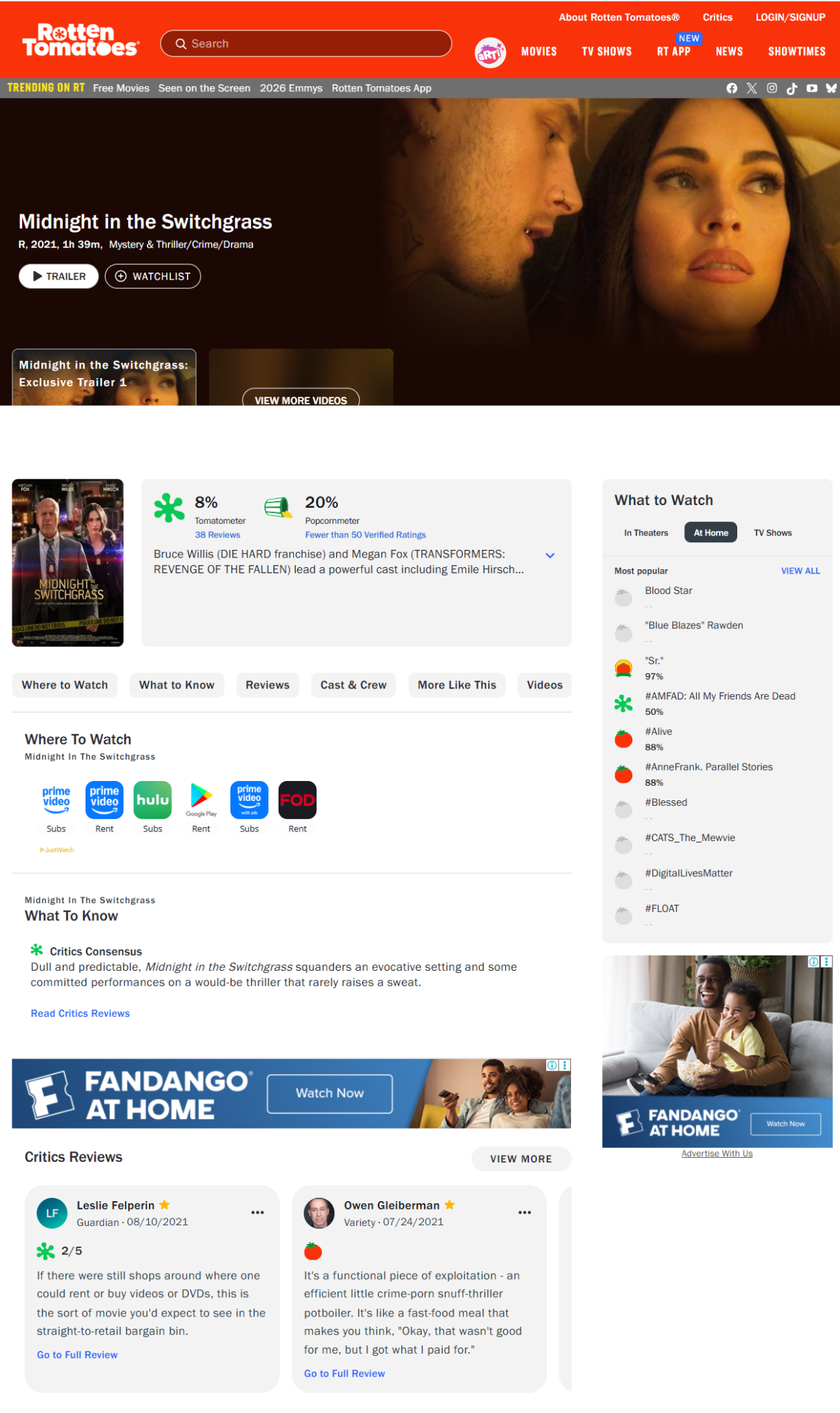
I should have known the original title of “Midnight Killer” first, and even in a 2-sec Google Search, I could have seen some Korean actors’ names if I looked more closely.
Also, I don’t always believe in Rotten Tomatoes ratings, especially for anything getting 50-80% scores, but this could be a little help avoiding it.
Still, there are some good things, at least I can ask you to list the obvious plot holes and enjoy it. Here I got some out of tens of them:
– The grieving mom, Ms. Kellogg, seemed not to have seen her daughter’s body, even though it was under the local police’s investigation in a small village, where there were supposed to be only 1-2 cops, regarding Byron being a solo investigator. But I thought I saw 10-ish cops in the opening scene.
– I haven’t seen even a second of Byron’s shoot-out after he grabbed a couple of guns. But ok, the camera was just not rolling then.
– The gas station’s survey cam didn’t even show what color or model of the big rig Peter drove. That was why Byron needed to see “another film”, which the clerk was secretly filming for unknown reasons.
Yes, this is exactly the sort of movie where the low rating becomes useful—not because 8% automatically means “objectively bad,” but because the critics’ consensus is describing the same disease you noticed: half-built backstories, generic thriller machinery, and investigation driven by coincidence rather than competent police work. Rotten Tomatoes currently shows 8% from critics and 20% from audiences.
Your three examples are good, though I’d classify them slightly differently:
The grieving mother apparently not having identified or viewed her daughter’s body is less a hard contradiction than a glaringly missing procedural bridge. The film wants Ms. Kellogg to remain a wandering grief device rather than someone who has already dealt extensively with police, the morgue, and identification. Meanwhile, the opening visually implies a much larger response than Byron’s later “lonely cop personally carrying the whole investigation” storyline. The movie keeps changing the apparent size of law enforcement according to the needs of each scene.
Byron’s arsenal is wonderful anti-Chekhov. He interrupts an urgent rescue to go home, has the obligatory strained family conversation, and collects enough weapons to invade Peter’s property—then the climax largely becomes finding the correct address and arriving. One review notes that the film contains no conventional shootout or chase at all, so the gun-fetching scene mostly manufactures the appearance of escalation without producing any payoff.
The gas-station footage is perhaps the purest example of plot-required surveillance incompetence. The official camera catches so little useful information that Byron needs the clerk’s mysterious private recording, which conveniently contains exactly the clue the screenplay needs. The plot summary really does reduce the solution to Byron reviewing gas-station footage, identifying Hillborough, and arriving in time.
A few more entries for the Midnight Killer Logic Museum:
The FBI sting is absurdly understaffed. Rebecca knowingly meets a violent suspect as bait, yet backup is so weak or distant that she can be drugged and removed. Karl then effectively exits the useful portion of the investigation. Even the basic synopsis describes the operation as a sting that “goes horribly wrong,” but the movie never makes the failure feel like sophisticated counterplay by Peter; it looks like agents simply neglected ordinary safeguards.
Rebecca repeatedly substitutes aggression for procedure. She is depicted as tough because she threatens, hits, and provokes suspects, but this often damages cooperation and creates danger without producing evidence. It is screenwriter shorthand for “obsessive brilliant cop,” except the brilliance portion was left in another draft.
Nobody treats Peter’s truck as the enormous investigative gift it is. The killer operates around truck stops, abducts women, and transports them in a large commercial vehicle. That should generate witness descriptions, traffic cameras, toll or fuel records, company information, vehicle registration, and a limited suspect pool. Instead, the truck remains practically invisible until one lucky video supplies the answer.
Peter’s home life exists in a different movie. His wife and daughter receive enough scenes to establish that he is a suburban family man, yet apparently notice remarkably little about his movements, vehicle, behavior, or the secured structure on their property. Their backstory does not complicate the hunt or help expose him; it mostly says, “Serial killers can have families,” repeatedly.
Tracey’s escape depends on Peter becoming selectively incompetent. He has supposedly abducted and killed multiple women, but his containment setup allows the prisoners enough opportunity to coordinate and escape. It is not presented as him deteriorating psychologically or becoming reckless after years of success. The security level merely drops when the finale needs movement.
Byron solves the case alone because the screenplay forbids him from requesting help. Even the published synopsis explicitly says he proceeds “without asking for assistance from fellow law enforcement agents.” That is not really a character strength when a kidnapped federal agent may die within hours. It is how the movie manufactures a one-man climax after previously showing police, FBI personnel, and interagency involvement.
And Bruce Willis’s Karl may be the largest structural hole—not because every character must become heroic, but because the movie promotes him as a lead, gives him a partner and personal doubts, and then largely removes him. Reviews repeatedly noted that Willis is “missing in action” and that the personal material feels half-built. The character does not fail in a dramatically meaningful way; he simply stops occupying the screenplay.
So the film’s governing rule seems to be:
Every institution is exactly one person large, unless the shot needs police lights in the background.
And yes, Amazon’s ミッドナイト・キラー title completes it. Midnight in the Switchgrass at least promises a geographically specific, atmospheric crime story. Midnight Killer promises Generic Serial Killer Product No. 47—and, for once, the localized title may be more honest than the original.
#AiSlop #MovieExplained #MidnightInTheSwitchgrass #PrimeVideoJapan