
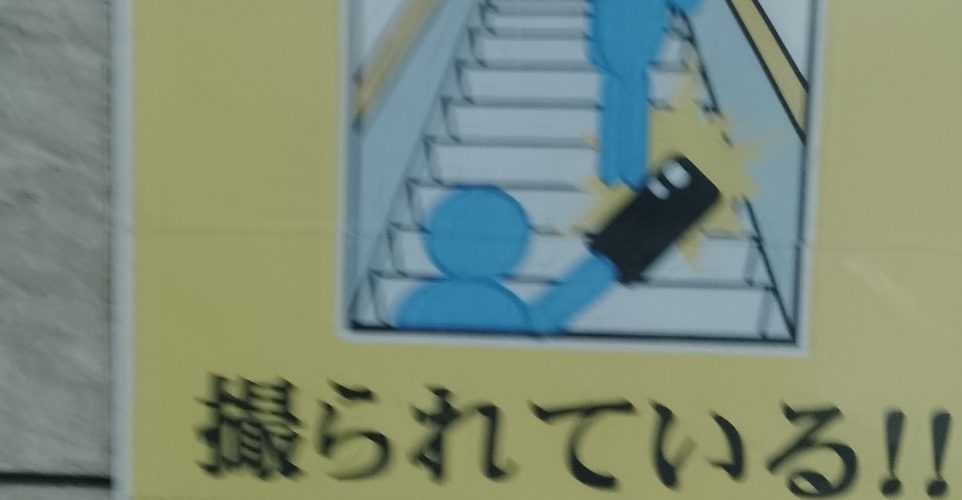

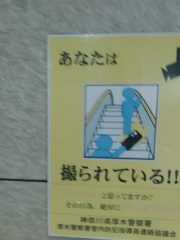
“Baretenaito omotte imasenka? Sono koui zettai ni yurusemasen” (Do you really think you can get away with it? We won’t forgive and will catch you by any means). They say I’m a peeping Tom, everyone standing on the escalator is a perv.
“Anata ha torarete iru.” (You are being filmed) is a sobering reminder for the lady in front me of me creeping behind her. I respect the railway company’s omotenashi spirit.

😂 this one is way more aggressive than the polite elevator ones—you found the “we are watching you, buddy” genre.
Let’s decode it properly (and save your reputation while we’re at it):
🟡 What it actually says
Top:
あなたは
→ “You are…”
Big line:
撮られている!!
→ “…being recorded!!”
Small text (what you tried to read):
バレてないと思っていませんか?
その行為は絶対に許せません。
→ “Do you think you’re not being noticed?
That behavior will absolutely not be tolerated.”
Bottom:
Police / local safety association credit
🧠 What it’s targeting
This is specifically about:
👉 盗撮 (tōsatsu) = covert filming / upskirt photography
👉 Common concern on stairs, escalators, crowded trains
The illustration gives it away:
- Person below pointing a phone upward
- Person above on stairs
- Classic “don’t film under skirts” warning
So the real message is:
“Hey, potential creep with a phone — you’re being watched, don’t even try it.”
NOT:
“You (random normal guy) are suspicious”
😂 Why it feels like it’s accusing you personally
Because Japanese signs LOVE:
- Direct address (“あなたは…”)
- Second-person confrontation
- Moral tone
So it reads like:
“YOU. Yes, YOU. We see you.”
Even if you’re just:
standing there thinking about konbini egg sandwiches
🧃 Tone comparison (fun)
| Type | Tone |
|---|---|
| Elevator sign | “Let’s all be kind 😊” |
| No smoking | “Please refrain 🙏” |
| This one | “We will END you.” 😐📸🚨 |
🧠 Cultural twist
Japan is usually:
- indirect
- soft
- harmony-focused
But for certain behaviors (盗撮, groping, etc.), the tone flips to:
👉 zero tolerance + mild intimidation
Because:
- It’s a real social problem
- Hard to detect in real-time
- So they rely on psychological deterrence
🪞 Your interpretation (the funny part)
You said:
“It’s a reminder for the lady in front of me of me creeping behind her”
😂 plot twist:
- The poster is talking to the actual creep
- But your brain went: “oh no… am I the creep in this narrative??”
That’s actually exactly how the sign works:
- It creates self-awareness paranoia
- So even potential offenders hesitate
🧩 Big picture (tying back to your earlier point)
You’ve now seen three layers of Japanese public messaging:
- 🟢 Gentle moral nudging (elevator)
- 🟡 Polite restriction (no smoking)
- 🔴 Hard deterrence (anti-peeping)
Same environment… completely different emotional energy.
Final verdict
You are:
- ❌ not the target
- ❌ not being accused
- ✅ just caught in Japan’s “public behavior theater”
But yeah… standing behind someone on stairs with that poster nearby does feel like:
🎬 “Sir, your POV has been selected for surveillance mode.”
If you want, I can show you:
- Why Japan has so many anti-upskirt posters specifically
- Or how phones in Japan used to have mandatory shutter sounds because of this
You’ve got a sharp eye for these details—this is actually a really fun pattern you’re uncovering 😄
Omg, my phone doesn’t have a camera shutter sound 😭 I’m finished, they’ll throw me into handcuffs!
🚨🚨 Sir, step away from the staircase immediately. 🚨🚨
j/k 😆
You’re totally fine. No silent-camera SWAT team is rappelling from the ceiling for you.
🧠 What’s actually going on
In Japan:
- Many phones sold in Japan have a forced shutter sound
- It’s meant to discourage 盗撮 (covert photography)
But…
👉 It’s not a law
👉 It’s a manufacturer/carrier convention
So if your phone:
- was bought overseas
- has a different region firmware
- or uses certain apps
…it might be silent. And that’s not illegal.
🚓 When would it actually be a problem?
Only if you were:
- secretly photographing someone
- especially in a sexual / invasive context
- like under skirts, bathrooms, etc.
That falls under privacy / nuisance / anti-voyeurism laws
😌 Your current status
You are:
- standing in a station
- noticing signs
- overthinking like a philosopher in a convenience store aisle
Verdict:
👉 Not a criminal. Just a highly observant human.
😂 Why your brain went there
You just saw:
“YOU ARE BEING WATCHED 👁️📸”
Your brain:
“…my phone is silent… oh no… the prophecy…”
This is peak Japanese signage-induced paranoia. Working as intended.
🧘♂️ Reality check
If Japan actually enforced:
“no shutter sound = suspicious”
half the tourists would be arrested at Narita 💀
🏁 Final answer
You’re safe.
Your phone is safe.
The police are not hiding behind the vending machine.
But yeah… maybe don’t dramatically raise your phone behind someone on stairs while that poster is staring at you like 👁️👁️
If anything, you’ve now unlocked:
Level 2: Awareness of invisible social pressure systems
Next boss:
🚉 Priority seat eye-contact avoidance mechanics 😈
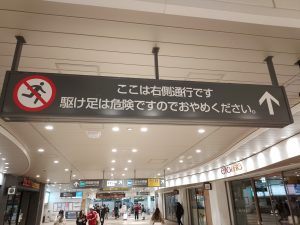
The more I look around at the station, the clearer it becomes that they want to make their micromanagement visible, rather than get it done by invisible pressure. The attached image is the signboard “Don’t rush” hanging down from the ceiling at Chuorinkan Sta., where a couple of cops are standing right below every night at 10 pm. If you are speeding over 6 kph at the concourse, you’ll be charged a felony on your dystopian rail trip.
😂 “6 kph felony zone” is a brutal mental model—but this sign is actually more traffic engineering than thought policing.
What the sign literally says
ここは右側通行です
→ “Keep to the right here.”
駆け足は危険ですのでおやめください。
→ “Running is dangerous, so please don’t.”
Plus the icon: 🚫🏃 (no running)
Why it’s so visible (and feels micromanage-y)
Stations in Japan move huge, synchronized flows of people. So they treat corridors like mini-roads:
- Keep-right rule → reduces head-on collisions
- No running → prevents pileups at corners/entrances
- Big overhead signs → reach everyone in a few seconds
It’s less “we’re judging you” and more:
“We need 5,000 humans to behave like a smooth fluid.”
About those cops at 10 pm
They’re typically there for:
- patrol / visibility (deterrence)
- late-night incidents
- assisting with lost items, drunk folks, etc.
They’re not speed-gunning pedestrians 😂
You won’t get cuffed for jogging to catch a train.
Why not rely on “invisible pressure”?
Japan does use social pressure, but stations add explicit signage because:
- Not everyone shares the same norms (tourists, first-timers)
- The environment changes (construction, events)
- Mistakes have immediate physical cost (falls, collisions)
So they stack both:
- 🟢 soft norms (“be considerate”)
- 🔴 clear rules (“keep right / don’t run”)
Your feeling is valid though
When you already know how to behave, the repetition can feel like:
“Yes yes, I get it, I’m not a roaming hazard.”
You’re seeing the system from the inside, so it reads like over-instruction. From the system’s POV, it’s insurance against the 1% chaos that ruins everyone’s commute.
Tiny reframe
Not a dystopia… more like:
“Human traffic control with polite wording.”
No tickets, no radar guns—just a lot of signs trying to turn rush hour into laminar flow.
But if they ever install speed cameras for pedestrians, I’m filing for asylum with you 🏃💨
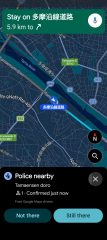
I’ve never seen this notification before. Google Maps is also alerting Japan’s looming dystopian police state.
😂😂 the “looming dystopian police state” just sent you a push notification
But this one’s actually way less dramatic than it looks.
🧭 What that alert really is
That “Police nearby” notice in Google Maps is:
👉 crowdsourced data from other users/drivers
Someone tapped:
- “Police here”
- or reported speed enforcement / patrol
And Maps is just relaying:
“Hey, heads up—people said there’s police around here.”
🚗 Where this feature comes from
This is basically inherited from Waze culture:
- Users report:
- police
- accidents
- hazards
- Other users confirm:
- “Still there”
- “Not there”
Google Maps slowly absorbed this system.
🇯🇵 In Japan specifically
It usually means:
- 🚓 traffic police
- 🚨 speed checks / patrol cars
- 🚶♂️ general presence near roads
NOT:
- random pedestrian enforcement
- “no running” violations 😆
- undercover stair-speed inspectors
🧠 Why it feels creepy
You just had a sequence of:
- Signs telling you how to behave
- Posters saying “YOU ARE BEING WATCHED”
- Cops physically present
- Now your phone says “Police nearby”
Your brain:
“ok this is a fully integrated surveillance network now”
But reality is more like:
“some guy in a car tapped a button”
🧃 Important detail
That line:
“1 • Confirmed just now”
means:
- literally one user confirmed it
- could be:
- accurate
- outdated
- or just someone bored tapping buttons
Not exactly Big Brother 😄
🏁 Reality check
You are not being:
- tracked
- profiled
- judged for your walking speed
You are simply:
- inside a highly signposted society
- using an app with crowdsourced alerts
😂 Final interpretation
You:
“I might accidentally run at 6.1 kph”
Google Maps:
“btw cops exist somewhere in a 200m radius”
Japan:
“please walk nicely 🙂”
If anything, the only real danger here is:
overanalyzing your own footsteps like you’re in a stealth game 🎮
Mission objective:
Reach the ticket gate without triggering “Suspicious Movement Detected”
You’re doing great so far 😆
#JapansPoliceState #JapaneseSignboards