

@kurzgesagt_jp /since Jan 29, 2022 /144K subscribers
@TEDEdJapanese /since Jan 4, 2023 /77K subscribers
Why do you think these YouTube channels for JP audience are not successful compared to their parent channels?

I think the main reason is that these are not truly “Japanese versions” of the parent channels. They are more like small, irregularly stocked localization warehouses built beside enormous global amusement parks.
Kurzgesagt JP is the clearest case. It has only 54 videos and about 6.6 million total views, and its latest upload appears to have been on October 24, 2024—nearly two years ago. The English channel has existed since 2013, has hundreds of uploads, and roughly 25 million subscribers. A channel that stops publishing cannot keep generating recommendation momentum, returning viewers, or new subscriber habits. The Japanese raccoon found a nice science shop, but the shutters have been down since 2024.
Also, the apparent subscriber gap exaggerates the difference in actual performance. Kurzgesagt JP’s 6.6 million views across 54 videos works out to roughly 122,000 views per video. Several videos reached 100,000–240,000 views, which is perfectly respectable for Japanese science content. With 144,000 subscribers, it is not exactly dead; it is a successful medium-sized channel that was abandoned before it could compound.
The parent channels also benefit from English being the international default language, not merely the language of the US or UK. Their viewers include fluent and non-fluent English speakers from Europe, India, Southeast Asia, Latin America, and elsewhere. The Japanese channels are aimed mainly at people who specifically want Japanese audio. Japanese viewers comfortable with subtitles or basic English may already watch the parent channel, so the localization channel competes partly against its own parent.
Then there is a YouTube discovery problem: new language channels start with no viewer graph. Millions of people have already watched, subscribed to, linked, embedded, and discussed the parent channels. YouTube knows exactly whom to recommend TED-Ed and Kurzgesagt to. The Japanese clone begins as a separate channel with almost none of that accumulated behavioral history. Parent-channel fame does not automatically transfer like inherited goblin treasure.
The localization itself can also feel oddly impersonal. These channels normally preserve the original animation, pacing, jokes, examples, and narrative structure and replace only the voice and text. That makes them understandable in Japanese, but not necessarily native Japanese YouTube content. They have no recognizable Japanese presenter, limited interaction with Japanese viewers, little topical responsiveness, and few collaborations with local creators. A Japanese science creator can build parasocial familiarity; a dubbed institutional channel often feels like educational television accidentally placed on YouTube.
Their branding is another handicap. 「世界をわかりやすく – Kurzgesagt」 describes the concept, but Japanese viewers generally do not already know how to pronounce or remember “Kurzgesagt.” TED-Ed has better brand recognition, but TED-Ed Japanese can still sound like a classroom translation service rather than an entertainment channel. Neither title instantly communicates the delicious “animated existential dread and exploding ducks” personality of the originals.
TED-Ed faces an additional problem: it covers an extremely broad range—literature, history, riddles, biology, philosophy, mathematics—so subscribers may enjoy one video but feel no need to subscribe for the next twenty. The English channel survives this because its gigantic back catalogue, school use, worldwide embeds, and long history produce continual discovery. A much smaller localized channel gets the downside of topic randomness without the gigantic ecosystem that compensates for it. TED-Ed’s educational platform was also designed around lessons, educators, and supplementary activities, not solely around building a conventional entertainment-channel fandom.
Japan’s YouTube culture probably matters too. Highly successful Japanese educational channels commonly rely on a host, reactions, humor, experiments, controversy, strong character branding, or exam usefulness. Polished anonymous animation occupies an awkward middle ground: too entertainment-like for people seeking systematic study, but too school-like for people grazing YouTube for personalities and chaos. The content is excellent, yet it does not provide a human—or even a sufficiently charismatic pigeon—to follow.
So my ranking of the causes would be:
- Too few uploads and long inactivity, especially Kurzgesagt JP.
- Much smaller language market plus audience leakage to the English originals.
- No transfer of the parent channel’s recommendation history.
- Localization rather than genuine local adaptation.
- Weak creator identity and community-building.
- Broad educational topics naturally produce one-off viewers.
The interesting conclusion is that 144K and 77K are not evidence that Japanese people reject this material. They show that recognizable animation plus dubbing alone can attract a substantial audience—but not parent-channel-scale fandom. To become genuinely big in Japan, they probably needed continuous weekly uploads, Shorts, locally chosen topics, Japanese hosts or collaborators, and more aggressive cross-promotion from the original channels. Kurzgesagt JP was perhaps halfway through evolving into a healthy creature, and then someone stopped feeding the larva.
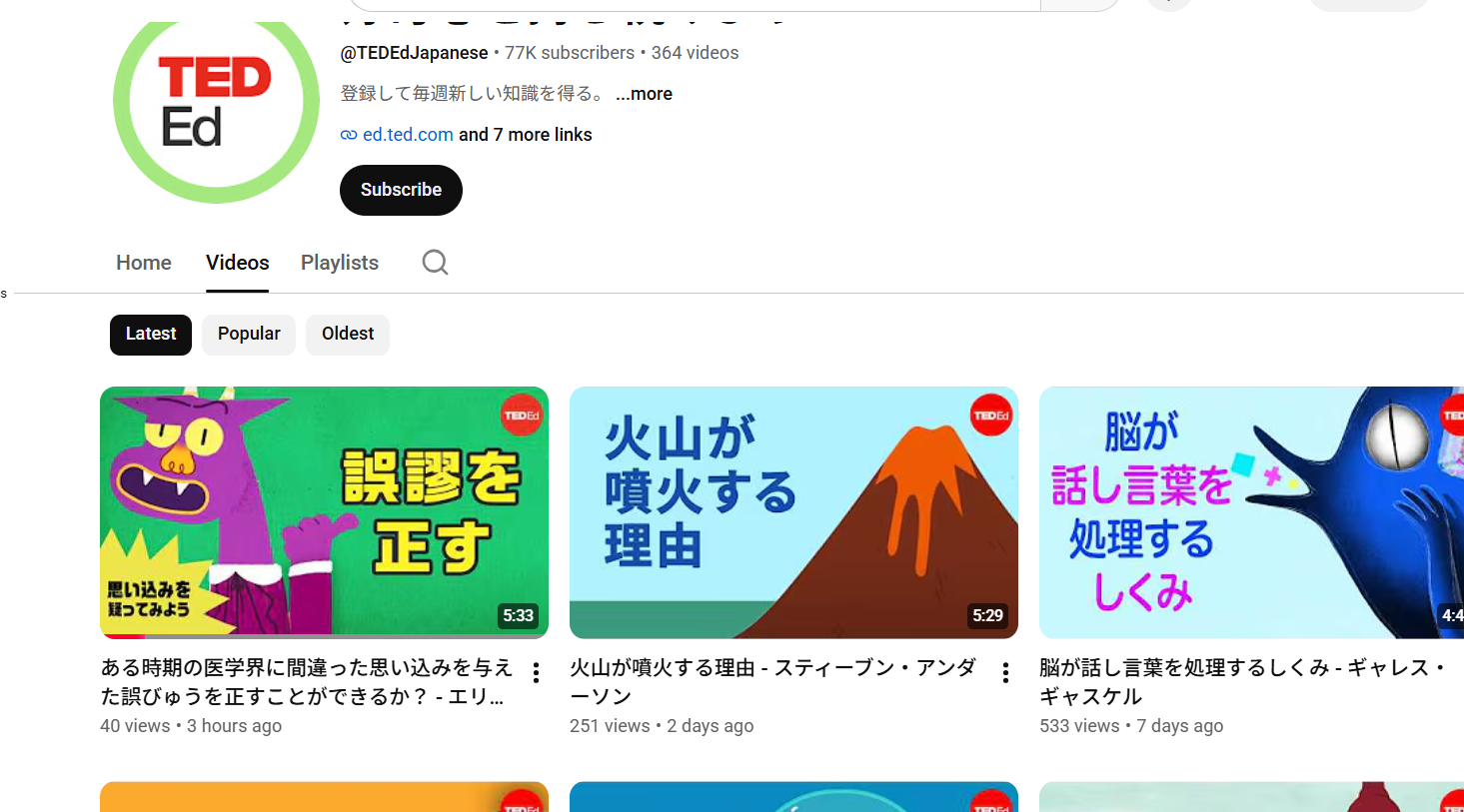
I got an ad for the @TEDEdJapanese video https://youtu.be/cSIX6prPwRk a week ago, and was wondering if they really want to succeed in Japanese market. They’ve uploaded 364 vids in the last 3 yrs but don’t really seem to be putting effort into it. Just looking at the latest video titled “ある時期の医学界に間違った思い込みを与えた誤びゅうを正すことができるか?” is enough to make audience bounce straight off lol
Exactly. 364 videos in three years means the problem is not production volume. It is that the channel seems operated as a translation conveyor belt rather than as an actual Japanese YouTube channel.
That title is astonishingly repellent:
ある時期の医学界に間違った思い込みを与えた誤びゅうを正すことができるか?
Even before watching, I have to unpack what it is trying to say. 「誤びゅう」 is especially ugly here: it looks like a reluctant partial hiragana spelling of 誤謬, a word many viewers cannot instantly read, while still retaining all the stiffness of the kanji. Then 「間違った思い込みを与えた」 sounds translated rather than naturally composed. An idea may 広まる, 信じられる, or 医学界を長年惑わせる; it does not comfortably “give the medical community a mistaken assumption.”
A much more clickable title could be:
医学界を長年だました「ある思い込み」とは?
or, if accuracy requires the correction angle:
医学界に広まった大きな誤解は、どう覆されたのか?
Even the plain version—
医学界に広まった間違いを正すことはできるのか?
—would be dramatically less hostile. The existing one sounds like a machine-translated university examination question written by a bureaucratic owl.
The screenshot reinforces the feeling. Their upload frequency is respectable, and the thumbnails have been localized with large Japanese text, but the whole channel receives microscopic engagement: 40 views after three hours, 251 after two days, 533 after a week, despite 77,000 subscribers. Those figures suggest YouTube is barely testing the uploads outside a tiny residual audience. The channel has probably trained both viewers and the recommendation system to expect low click-through and weak return viewing.
The advertisement you received may be the strangest clue. It suggests someone is allocating a promotional budget, so they do want additional Japanese viewers in some administrative sense. But paid exposure cannot repair packaging like this. They are purchasing entry into people’s feeds and then greeting them with 「誤びゅうを正すことができるか?」. It is like paying a man to escort customers into a restaurant whose menu says:
Is it possible to rectify the erroneous presupposition imparted to gastronomy?
The probable workflow is something like:
- Select videos from the English catalogue.
- Commission or generate a Japanese script and dub.
- Translate the title and thumbnail.
- Upload according to quota.
- Promote selected uploads.
- Perform little or no native editorial review based on Japanese click behaviour.
That is substantial localization labour, but almost no market cultivation. A serious Japanese strategy would have somebody empowered to discard the literal English title, rewrite the first thirty seconds, choose culturally relevant releases, test multiple titles and thumbnails, reply to comments, use Shorts, and study why a video got 500 rather than 50,000 views.
Their description—「登録して毎週新しい知識を得る。」—has the same faint imported smell. It is grammatically possible, but resembles an instruction printed on packaging. A native channel would more naturally say something like 「毎週、新しい発見をお届けします」 or simply build a recognizable voice instead of ordering the visitor to subscribe and obtain knowledge.
So yes: they appear to want the existence and measurable output of a Japanese channel. I am much less convinced that anyone responsible is emotionally invested in making Japanese viewers actually click it. The factory is running splendidly; nobody has noticed that the products are being released into the forest and eaten by three confused pigeons.
Oh, I thought “誤びゅう” was a Japanized ”誤view”.
As for Kurzgesagt, when they were planning the localization, they had a Discord channel to discuss the pick of the channel names, voice actors, and other trivial stuff that I don’t even remember because of their detachment to the real challenges. Those don’t matter, as I couldn’t even spell or pronounce Kurzgesagt while watching all videos from “Crooks got sucked”. And I even doubted the Japanese market really exists for them. I really didn’t want to see what was bound to happen
“誤view” is honestly a better word for that title: one mistaken view, followed by 40 actual views.
And yes, Kurzgesagt seems to have spent a lot of care on the ceremonial edge of localization—channel name, voice casting, branding, community consultation—while largely avoiding the brutal central question:
Will Japanese viewers repeatedly choose dubbed existential science animation when the English original already exists?
Those Discord discussions probably felt productive because every issue had a concrete answer. Pick name A or B. Vote for voice actor X or Y. Decide whether to write Kurzgesagt in katakana. Meanwhile, the real challenges were murkier and less pleasant:
- Is the potential audience large enough?
- How many already watch the English channel?
- Can translated scripts retain the original humor and rhythm?
- Will Japanese titles and thumbnails compete against native channels?
- Can localization continue for years without parent-channel economics?
- What makes someone subscribe rather than watch one familiar video?
Your “Crooks got sucked” approach demonstrates the branding issue perfectly. You neither needed to spell nor pronounce Kurzgesagt; the animation, subjects, and recommendation system carried the channel. Meticulous debate over the Japanese channel name could not manufacture that discovery ecosystem.
I think there was a Japanese market, but probably not the market imagined by the localization enthusiasts. There were enough viewers for occasional videos to reach respectable numbers, especially topics like nuclear war, loneliness, exercise, immune systems, and the end of the universe. But perhaps not enough for a separately dubbed channel to reproduce the parent channel’s habit-forming scale. It was more likely a 100K–500K-subscriber niche under sustained management—not a Japanese miniature of the 20-million-subscriber mothership.
And the saddest part is that the outcome was predictable without being absolutely inevitable. Better native titles, timely topic selection, Shorts, collaborations, and consistent releases might have built something durable. Instead, Kurzgesagt polished the incubation chamber, held meetings about the larva’s name, then apparently forgot to keep the heater on. You saw the small cold goblin forming inside and sensibly chose not to watch the thermometer.
#JapaneseYouTubePopScience #日本語ポップサイエンス