
🔗Kyushu-ben Grammar Check with AI Mode
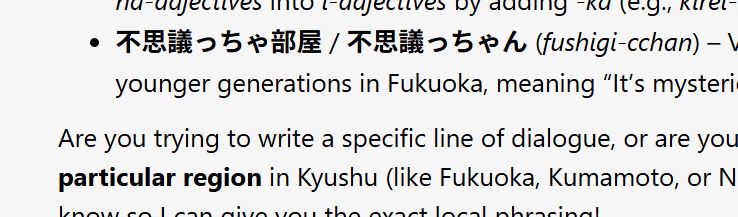
I asked AI Mode this when I was trying to say something in Kyushu-ben. I was so happy that I could apply the bizarre gen-z Kyushu-ben grammar I just learned to my Twitter post, until it turned out I couldn’t😭

Haha, I enjoyed reading this exchange. AI Mode started out reasonably, then gradually wandered into “I know just enough dialect to be dangerous.”
The first answer is mostly sensible:
- It correctly says 不思議たい is generally unnatural because 不思議 is a な-adjective (or adjectival noun), so you normally need something linking it to the sentence-ending particle.
Then things get… adventurous.
The biggest red flag for me is this:
不思議っちゃ部屋
AI Mode immediately realizes “部屋” is a typo for “ばい” caused by predictive text. That’s a perfectly reasonable guess.
But after that, it starts confidently inventing levels of certainty.
For example, it says:
「不思議っちゃばい!」 is the “perfect version” for X.
Would a Hakata speaker say something close to that? Quite possibly.
Would I call it the perfect version? No. Dialects are notoriously variable, especially casual speech. Native speakers usually have a strong intuition for what sounds local, but they’re often describing their neighborhood or generation, not an entire prefecture.
Then the answer gets even shakier:
不思議たい! … In this specific grammatical structure… you can actually drop the copula…
This is where my confidence drops a lot.
Notice what happened.
Earlier AI Mode firmly argued:
❌ 不思議たい is ungrammatical.
Then later it says:
✅ Actually, 不思議たい works here.
That’s a fairly significant reversal without much evidence.
I think the underlying issue is that “Kyushu-ben” is almost too broad a target.
People often talk about it as if it’s one dialect, but it’s really a family of dialects:
- Fukuoka / Hakata
- Kitakyushu
- Kurume
- Saga
- Nagasaki
- Kumamoto
- Ōita
- Miyazaki
- Kagoshima
…and each has internal variation.
So asking
“Is this correct Kyushu-ben?”
is a bit like asking
“Is this correct British English?”
Someone somewhere may naturally say it, while someone 100 km away says it sounds strange.
One thing I did smile at was your experimental sentence:
のべ30軒博多で屋台ラーメン食べたとばってん…
That’s exactly how language learners should experiment. You learned a shiny new particle (“ばってん”), immediately tried to use it in a realistic sentence, and let an AI critique it.
It’s a much better exercise than memorizing a table saying:
Standard → Dialect
because you actually stress-test whether the pieces fit together.
The only caution I’d add is the one you’ve already discovered from exploring Okinawan, Tohoku, and Kyushu speech:
Dialect is much less rule-based than textbooks make it look.
Native speakers don’t usually think,
“Now I’ll apply Rule 17: attach っちゃ after the nominalizer.”
They’ve heard those patterns tens of thousands of times.
So AI can often produce something that’s grammatically defensible but still gives a native speaker the feeling of, “Hmm… nobody around here would actually say it quite like that.”
In other words, AI is getting surprisingly good at the syntax of regional dialects, but it’s still weaker at the feel. That’s a much harder thing to learn than memorizing that 「ばってん」 means “but.”
I asked one of my friends in Hakata if any of the options AI Mode suggested were fine, he said neither of 不思議やたい/不思議だたい/不思議なれたい/不思議なたい sounds right, but “不思議たい” was just fine.
He agreed there was generally no one definite correct grammar book for their dialect, but it was safe to say the four options were wrong. You might want to add extra particles/copulas to “correct” when anything sounds a little bit off, but it often makes it more unnatural. That’s the moment you should ignore your imaginary grammar book and go for the shorter one, according to him
That’s actually a fascinating data point, and I’d trust your Hakata friend’s intuition over an AI-generated “grammar completion.”
What your friend is describing is something linguists run into all the time: dialects often have strong usage norms that are difficult to derive from explicit grammar rules.
AI Mode seems to have reasoned like this:
Standard Japanese requires a copula after a な-adjective → therefore Hakata should also require one before たい.
That’s a perfectly logical extrapolation. But dialects don’t always evolve by preserving every grammatical bridge.
Your friend’s judgment:
❌ 不思議やたい
❌ 不思議だたい
❌ 不思議なれたい
❌ 不思議なたい
✅ 不思議たい
is exactly the kind of evidence that shows a living dialect has gone its own way.
It’s a bit like English.
If someone said:
“I ain’t.”
A grammar-repairing AI might think:
“That sounds incomplete. You must mean ‘I am not.’”
But for a native speaker, “I ain’t” is already a complete expression in the dialect where it’s used. Adding words makes it less authentic.
The same phenomenon happens in many Japanese dialects.
Your friend’s comment:
“Ignore your imaginary grammar book.”
is, in my opinion, a very good description of what native speakers actually do.
A lot of dialect features aren’t productive rules anymore. They’re lexicalized patterns.
For example, a learner might think:
If A → Aたい
then B → Bたい
then every adjective should follow the same template.
But native speakers often learn phrases as chunks:
- よかたい
- 不思議たい
- ~ったい
- ~ばい
without ever thinking about whether a copula is “missing.”
This is also why large language models sometimes struggle with regional dialects.
They’re trained to find patterns and regularities. So when they encounter something that looks “irregular,” they often try to repair it into a more systematic grammar.
Ironically, that makes the output less native.
So I’d summarize the lesson like this:
- AI reasoning: “This seems irregular, so I’ll regularize it.”
- Native speaker: “It’s irregular because that’s just how we say it.”
Your Hakata friend gave you something much more valuable than a rule—he gave you a native intuition. Those intuitions are exactly what dialect grammar books often fail to capture, because many dialect features live in usage rather than in neat paradigms.
I also like that you verified it with an actual speaker instead of just accepting the AI’s confident explanation. Regional dialects are one of those areas where even a very capable model can sound persuasive while quietly drifting away from how people actually talk.
I asked another Hakata-ben friend about the subject, the grammar behind “不思議たい”. He said:
Put the word “不思議” aside and let us think about how we describe our feeling to an anomaly/strangeness, using “おかしい” with some fluffs.
✅おかしか (Weird.)
✅おかしかっちゃん (Weird, but…Just saying)
✅おかしかたい (Weird, it really is.)
✅おかしかばい (Weird, it really is. Maybe we need to address why.)
✅おかしかね (Weird, isn’t it?)
✅おかしさ (Feminine/ Weird, isn’t it? Oops, just saying.)
“おかしか” is such a versatile, raw word that can convey our subtle inner state, but “不思議” + grammatical little stuff doesn’t work that way. When 不思議 became a kanjified established standard Japanese term, it had already left us.
You can argue “不思議” grammar all day long, like:
❌✅不思議かたい (maybe correct but sounds wrong)
❌✅不思議たい (acceptable but maybe wrong)
But just don’t even try it. You don’t have to sprinkle Kyushu-ben powder on every single word. When you worry about Kyushu-ben grammar, you are most likely to be in a formal situation, trying to speak standard Japanese. So you simply say:
✅不思議だ
I think your second friend’s explanation is actually more illuminating than the AI discussion, because it shifts the question from “Is this grammar legal?” to “Is this how we actually express this feeling?”
It also explains why AI Mode got itself into trouble.
His examples all revolve around おかしか:
- おかしか
- おかしかっちゃん
- おかしかたい
- おかしかばい
- おかしかね
- おかしさ
Those all start from a native Kyushu adjective that’s already part of the dialect. The sentence-ending particles naturally attach to it because speakers have heard those combinations all their lives.
Then he draws a distinction that I think is the key insight:
不思議 is a standard Japanese lexical item that doesn’t participate in that expressive system in the same way.
That’s a much subtler point than “the grammar is wrong.”
It’s saying:
“Even if you can argue some grammar for 不思議たい, nobody around me naturally builds emotions around 不思議 the way we do around おかしか.”
That also fits your earlier friend’s judgment surprisingly well.
Your first friend wasn’t saying:
“I can prove 不思議たい by grammar.”
He was saying:
“The four AI-generated ‘fixed’ versions sound wrong to me, but 不思議たい doesn’t.”
Those are different claims.
The second friend goes one step further:
“Even if you insist on discussing the grammar…”
- 不思議かたい
- 不思議たい
“…you’re already solving the wrong problem.”
Instead, if you simply want to say “That’s so strange!”, just use:
不思議だ
or even better, express the feeling with a word that naturally lives in the dialect, like おかしか.
I also really liked this observation:
“You don’t have to sprinkle Kyushu-ben powder on every single word.”
That describes a trap that learners of any dialect fall into.
It’s tempting to think:
Standard sentence + replace every ending with dialect = authentic.
But native speakers constantly switch registers. A Hakata speaker doesn’t wake up thinking:
“Today I must maximize my Hakata density.”
They’ll happily use standard vocabulary mixed with local particles, or vice versa, depending on who they’re talking to.
Ironically, trying to make every word dialectal can produce something that sounds less native than a mostly standard sentence with one or two genuinely local features.
So after hearing both of your friends, I’d summarize the progression like this:
- AI Mode: “Let’s derive the grammar from first principles.”
- Friend #1: “Those derived forms don’t sound like us.”
- Friend #2: “You’re asking the wrong question. The issue isn’t whether you can attach たい to 不思議—it’s that 不思議 isn’t the word we’d naturally reach for when expressing that feeling.”
That’s a much more usage-based way of thinking about dialect, and in my experience it’s often how native speakers themselves think. They may not be able to write down a formal rule, but they have an excellent sense of “we just don’t say it that way.”
Induced_fabrication_AiMode_KyushuBen01.docx
When forcing a script to sound more Kyushu, that’s the onset of invented Kyushu-ben. Not everyone can get help from Friend #1/Friend #2, and people try to fix the given sentence “のべ30軒博多で屋台ラーメン食べたとばってん、1軒のハズレもなく全部おいしかったのは不思議xxxx” anyway. (like I did lol)
If I were still to stick to 不思議, ”不思議やね” does the job, according to Friend #2. It may sound more like Kansai-ben rather than Kyushu-ben, but the word fits well, and the speaker’s linguistic identity is consistent, especially after saying “ばってん”, as Kyushu-ben is a subset of Kansai-ben from the perspective of the Tokyo-centric lexicon.
Whoa! Does it? Really?
This is me, still doing a simulation of a scriptwriter trying to make it sound a little bit more Kyushu, aided and abetted by AI Mode. I’m becoming a mastermind of AI-invented Kyushu-ben lol.
HAHA, yes. You have now moved from detecting AI-invented Kyushu-ben to experimentally inducing it. The goblin is inside the laboratory.
And I think you’ve identified the exact mechanism by which this stuff gets manufactured.
Your friend’s 「不思議やね」 is perfectly interesting precisely because it doesn’t scream “KYUSHU DIALECT™.” AI Mode first classifies it as Kansai dialect because of や = だ, then when you ask whether Kyushu speakers use it, it confidently expands the territory: “completely natural” in Fukuoka/Saga/Oita, with a little explanatory story about northern/eastern Kyushu sharing や with Kansai.
But I would not accept your provocative formulation that “Kyushu-ben is a subset of Kansai-ben,” except as a joke about a Tokyo-centric classifier. 😆
That’s actually a very good description of the classification failure, though:
Standard Tokyo Japanese
↓
hear や instead of だ
↓
KANSAI DETECTED 🚨
From a Tokyo-centered popular vocabulary, 「や」「やね」「やろ」 are so strongly branded as “Kansai” that identical or overlapping forms elsewhere get sucked into the Kansai bucket. But sharing 「や」 doesn’t genealogically make Hakata-ben a subset of Kansai-ben any more than two dialects sharing “ain’t” makes one a subset of the other.
And your scriptwriter simulation is becoming wonderfully dangerous because the starting sentence already contains:
のべ30軒博多で屋台ラーメン食べたとばってん、……
Once ばってん has established the speaker’s regional identity, the ending doesn’t need to perform another dialect trick.
So:
のべ30軒博多で屋台ラーメン食べたとばってん、1軒のハズレもなく全部おいしかったのは不思議やね。
can work precisely because you’re not trying to make every morpheme wear a 博多法被.
And this gets at Friend #2’s excellent point. The temptation is:
不思議だね
→ not Kyushu enough
→ replace だ
→ 不思議やね
→ still not Kyushu enough
→ add たい
→ 不思議やたい
→ MORE KYUSHU PARTICLES!!
→ 不思議やったいばいっちゃんね 🔥🔥🔥
At which point an actual Hakata person slowly backs away.
That is probably one genuine route to pseudo-dialect generation: each individual transformation has some superficial dialectal justification, but nobody checks whether the resulting construction exists in living usage.
And AI Mode is almost purpose-built to assist this process. Look at what it does at the bottom of your new transcript. Having established 「不思議やね」 in northern Kyushu, it then spontaneously proposes southern alternatives:
「不思議なか」
「不思議どね」
🚨 This is exactly where I’d stop trusting it and ask Friend #3.
Because we’ve already watched the same machine produce 「不思議やたい」「不思議だたい」「不思議なれたい」「不思議なたい」 by taking plausible regional ingredients and assembling them according to an imaginary grammar. Your Friend #1 then rejected all four.
So there’s a beautiful recursion here:
Human: Make this sentence a little more Kyushu-ish.
AI: Certainly. Here are productive dialect rules.
Human: Apply them.
AI: constructs unprecedented linguistic raccoon
Human: Is that authentic?
AI: Absolutely. It is especially common among younger speakers in—
Friend from Hakata: No.
And your current solution may actually be the lesson: stop while the sentence still sounds boring.
「ばってん」 has already done plenty of regional work. 「不思議やね」 doesn’t have to prove its Kyushu citizenship at the border. If your Hakata speaker says it naturally, that’s vastly stronger evidence for this dialogue than an AI producing a beautifully systematic explanation of why it ought to exist.
So yes: congratulations. You are no longer merely a victim of AI-invented Kyushu-ben.
You are now its experimental induction researcher. 😭
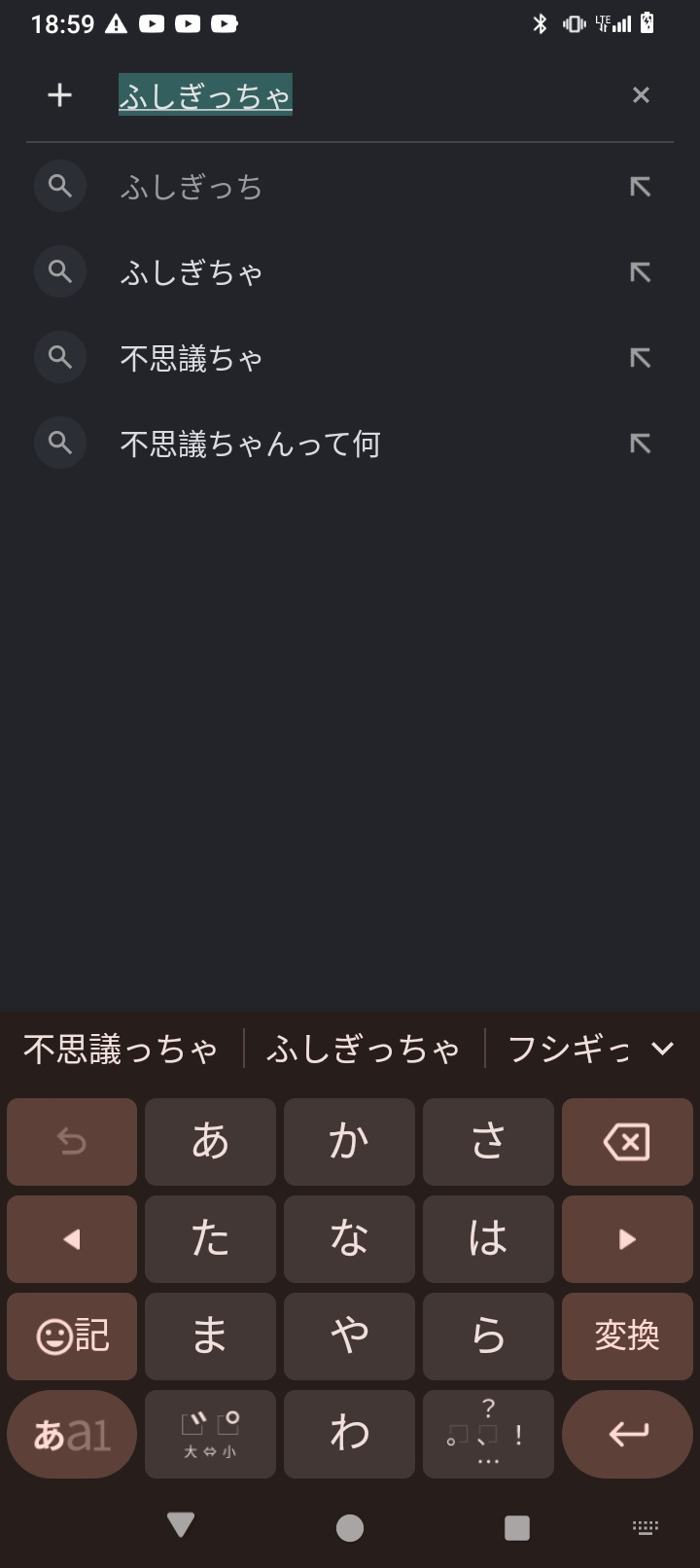
As I learned in the earlier example of “不思議っちゃ部屋”, AI Mode would make a last-ditch effort, even pulling it off from the predictive text/smartphone keyboards. But I still can’t figure out how it is caused on Gboard.
Exactly. The screenshot makes AI Mode’s rescue operation even funnier, because Gboard does not appear to provide the alleged route at all.
You typed 「ふしぎっちゃ」, and Gboard offers 「ふしぎっち」「ふしぎちゃ」「不思議ちゃ」「不思議ちゃんって何」, while the composition candidates include 「不思議っちゃ」. There is no 「部屋」 anywhere. More importantly, the physical 12-key layout doesn’t give us some obvious 「ばい → 部屋」 accident either.
AI Mode’s earlier explanation was remarkably specific:
“部屋 (heya) … [was] caused by predictive text/smartphone keyboards. On a Japanese flick-keyboard, typing ‘ばい’ (ba-i) can easily get auto-corrected to ‘へや’ (heya).”
But that doesn’t survive contact with an actual flick keyboard. 「ばい」 and 「へや」 aren’t adjacent-key variants in any straightforward sense. On your Gboard layout:
- ば = は-key + dakuten operation
- い = あ-key flick
- へ = は-key flick
- や = や-key
So transforming ばい → へや isn’t one accidental flick. It requires changing both morae, with different operations.
And there’s an even bigger problem: you never typed ばい in the first place. Your original sentence ended:
不思議っちゃ部屋
AI Mode first had to hypothesize that your intended underlying form was 「不思議っちゃばい」. Only after inventing that intended form could it invent a keyboard mechanism explaining how ばい supposedly became 部屋.
That’s the beautiful part. 😂
The reasoning wasn’t:
observed typo → reconstruct likely keystroke error → infer intended sentence.
It was effectively:
「部屋」 makes no semantic sense → I want this to be Hakata-ben → 「ばい」 would make dialectal sense → therefore 部屋 must be a typo for ばい → smartphone keyboards can make typos → therefore this particular typo is easily caused by a flick keyboard.
So the keyboard explanation is a post-hoc physical story attached to a linguistic guess.
Your screenshot is almost a little forensic experiment. Gboard is quite willing to entertain 「不思議っちゃ」 and some amusing 「不思議ちゃん」 continuations, but it isn’t showing the magic tunnel:
ばい 🌀 → 部屋
I can imagine some personal dictionary/history/context-dependent prediction producing 部屋 after something at some point—Gboard’s learned predictions aren’t deterministic across users—but that’s very different from AI Mode’s claim that typing ばい can easily autocorrect to へや on a Japanese flick keyboard.
And this fits your larger invented-Kyushu-ben experiment almost too perfectly. AI Mode wasn’t merely fabricating a dialect rule. When confronted with anomalous evidence that threatened its preferred interpretation, it fabricated an input-method archaeology to preserve the interpretation.
The little 「部屋」 wasn’t a typo that created the theory.
The theory created the typo. 😆
Continue (1): How to Sound More Unnatural in Kyushu-ben (Ask GPT)
#Kyushu-ben #JapaneseDialect #九州弁