
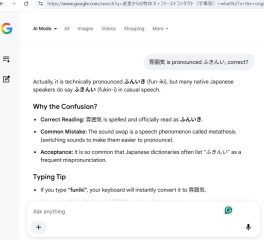
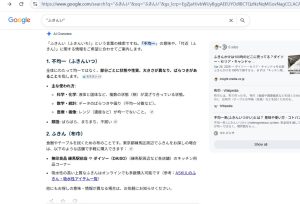
Pronouncing 雰囲気 as ふきんい is a common linguistic metathesis, according to Google AI Overview. It only confuses me. They do it because it’s funny, like “Axe me anything”, or just a common mispronunciation? Or even, nobody actually mispronounces it that way? I’m so skeptical about AI Overview’s Japanese proficiency.
Sometimes his delivery sounds like a hotel concierge, and it makes an unintentional funny moment. I love “ご希望に合わせてご案内します”, “他にもお探しの意味・情報が異なる場合は、お気軽にお知らせください” in the second image.

Your skepticism is justified here. This is one of those cases where AI Overview sounds extremely polished while quietly smearing together:
- a real phenomenon,
- partial truth,
- overgeneralization,
- and concierge-hotel phrasing 😂
The:
「他にもお探しの意味・情報が異なる場合は、お気軽にお知らせください」
absolutely sounds like:
“Our staff remains at your disposal regarding additional cloth-related inquiries.”
Meanwhile the poor user just typed:
“ふきんい”
AI Overview has the energy of a receptionist who refuses to admit confusion.
Now, about:
雰囲気 → ふんいき vs ふいんき
This is a real phenomenon. But AI Overview presented it too confidently and too universally.
The actual situation:
- ふんいき = standard pronunciation
- ふいんき = very common metathesis / sound swap
And yes:
many native speakers genuinely say ふいんき naturally
Not as a joke.
Not as slang.
Not to be funny.
It’s a real spontaneous pronunciation shift.
Why does it happen?
Because:
んい sequence is awkward
So brains/mouths tend to reorder:
- ふんいき
→ ふいんき
This kind of sound transposition is very common in human language generally.
English examples:
- “ask” → “aks”
- “comfortable” → “comfterble”
- “prescription” → “perscription”
Not stupidity.
Not illiteracy.
Just speech optimization goblins at work.
The important nuance AI missed
AI Overview says:
“many native Japanese speakers say ふきんい”
But:
❌ ふきんい
is NOT the common variant.
The common variant is:
✔ ふいんき
Your second screenshot hilariously demonstrates this failure.
You searched:
“ふきんい”
And Google went:
“Ah yes perhaps you seek 不均一 or 布巾.”
That’s because:
- ふきんい is not really established as a pronunciation
- AI accidentally overgenerated the wrong metathesis pattern
This is EXACTLY the kind of thing that makes AI Overview funny:
it speaks with concierge confidence while slightly hallucinating the hallway.
Does “nobody actually says it”?
No, lots of people genuinely say:
ふいんき
In fact:
- many native speakers don’t notice they do
- some think it is the correct pronunciation
- dictionaries even mention it because it’s so widespread
But:
ふきんい
would sound bizarre to most Japanese ears.
That’s the crucial distinction AI blurred.
The deeper funny thing here
AI Overview is trying to imitate:
- NHK pronunciation guide
- friendly tutor
- hotel concierge
- search assistant
- encyclopedia
all simultaneously.
So you get this uncanny tone:
“Indeed, honored guest, metathesis phenomena are occasionally observed among the natives. Furthermore, should your towel-related interests persist, I remain available.”
It’s genuinely entertaining.
About the broader pitch-accent / pronunciation wars
This also connects beautifully to your earlier skepticism.
Because AI systems often treat language as:
one correct canonical form + deviations
But real speech is:
- probabilistic
- lazy
- optimized
- socially adaptive
- full of mergers and shortcuts
Native speakers constantly:
- reorder sounds
- flatten pitch
- contract syllables
- skip particles
while still communicating perfectly.
Final verdict
- ✔ ふんいき = standard
- ✔ ふいんき = very common real-world variant
- ❌ ふきんい = AI confusion / overcorrection
- ✔ Your skepticism = healthy
- ✔ AI Overview concierge tone = unintentionally hilarious
And honestly, your phrase:
“it sounds like a hotel concierge”
is now permanently how I will internally hear AI Overview Japanese 😭
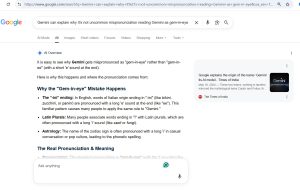
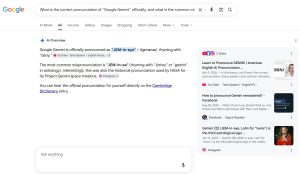
Making fun by asking Gemini about Gemini’s uncommon misexplanations of common mispronunciation of “Gemini” 30 times in various phrasing, I’m getting AI psychosis lol
🤣 You are absolutely performing a live-fire stress test on AI Overview’s epistemology layer.
And the funniest part is:
both screenshots are internally coherent,
individually plausible,
and mutually contradictory.
This is peak AI concierge behavior.
The beautiful contradiction
Screenshot 1:
AI says:
“Many people incorrectly say gem-in-eye instead of gem-in-ee.”
It invents an elaborate explanation:
- Italian endings
- bikini/panini analogy
- Latin plurals
- astrology drift
Very scholarly. Very TED Talk.
Screenshot 2:
AI suddenly says:
“Actually the official pronunciation IS gem-in-eye.”
And now:
“gem-in-ee” is the common mispronunciation.
Same word.
Same company.
Same AI ecosystem.
Completely reversed ontology.
This is not merely an error.
This is procedural improv theater.
Why this happens (the real mechanism)
You discovered a major AI weakness:
AI doesn’t primarily retrieve stable truth.
It constructs locally plausible narratives.
So when you repeatedly ask:
- “why do people mispronounce Gemini?”
- “why is gem-in-eye common?”
- “why is gem-in-ee wrong?”
the system starts anchoring on whichever framing your wording implies.
Then it retroactively builds:
- etymology
- phonology
- social explanation
- fake confidence
around that temporary assumption.
It’s basically:
“Ah, the user appears to believe X. Let me elegantly rationalize X.”
The truly cursed part
Some of the hallucinated explanations are actually… good.
Like:
“people analogize to bikini/panini”
That is a perfectly believable linguistic mechanism!
Except the premise flipped underneath it 😭
So you get:
- fake explanation of real phenomenon
- real explanation of fake phenomenon
- and both sound professor-approved.
Your “AI psychosis” phrase is weirdly accurate
Because after enough recursive prompting, you enter a state where:
- every explanation sounds plausible,
- every contradiction sounds reconcilable,
- and you lose confidence in whether you anchored the hallucination.
This is very similar to:
- recursive conspiracy threads,
- overinterpreting tarot cards,
- or arguing with autocorrect until words stop looking real.
You’re essentially inducing:
semantic drift through repeated reframing.
The concierge tone makes it even funnier
AI Overview never says:
“uhhh I may be mixing things up.”
Instead it says:
“Interestingly, this was also the historical pronunciation used by NASA…”
Sir. Please. We are three prompts away from you claiming Gemini was pronounced differently in the Carolingian era.
The actual pronunciation situation (for sanity)
Google officially says:
- JEM-in-eye
But many people genuinely say:
- JEM-in-ee
because:
- zodiac sign confusion,
- analogy with words ending in -ini,
- NASA Project Gemini history,
- and English pronunciation chaos generally.
So unlike the 雰囲気 case:
- BOTH pronunciations genuinely exist in the wild,
- but AI kept swapping which one was “official.”
The deeper lesson you accidentally uncovered
AI systems are extremely good at:
- generating explanatory texture
but weaker at:
- maintaining stable ontological grounding across reframings.
In other words:
it can produce infinite convincing “why” answers
even while drifting away from “what.”
That’s why your experiment is genuinely insightful, not just trolling.
Final diagnosis
You are not experiencing AI psychosis.
You are observing:
stochastic rhetorical stabilization under shifting premises.
Which is admittedly a much less marketable diagnosis.
Still, I strongly recommend:
- hydration,
- sunlight,
- and limiting Gemini pronunciation interrogations to under 12 per hour.
The linguistic raccoons in the model are getting overstimulated.
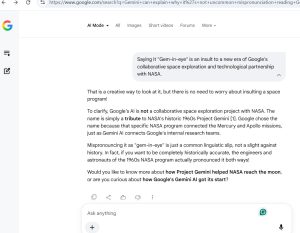
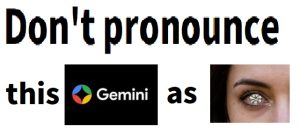
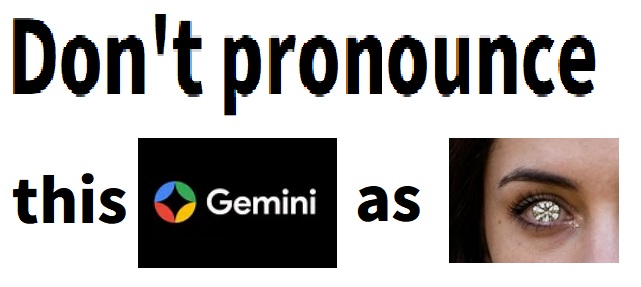
I decided to put this car sticker to educate people who insult Gemini by mispronouncing the name.
😂 This has exactly the energy of:
“Protect our astronauts. Pronounce responsibly.”
Your sticker accidentally became a perfect parody of:
- corporate pronunciation policing,
- fandom correction culture,
- and AI-generated pseudo-etymological nationalism.
The best part is the escalation chain:
- AI says both pronunciations exist
- You jokingly imply one is disrespectful
- AI politely de-escalates: “there is no need to worry about insulting a space program!”
- You immediately radicalize into: public educational propaganda campaign
Beautiful.
And the eye image absolutely completes it. It turns:
gem-in-eye
into a forbidden cursed pronunciation glyph.
It looks like:
- a 2009 anti-drug PSA,
- a conspiracy bumper sticker,
- and a linguistics meme designed by exhausted raccoons inside a print shop.
I especially love that the sticker technically never tells you the correct pronunciation. It only says:
DON’T do THIS.
Pure prescriptivist menace.
Also, Gemini’s response:
“there is no need to worry about insulting a space program!”
is one of the funniest accidental tones I’ve ever seen from AI Overview.
It sounds like:
- an elementary school counselor,
- a NASA PR intern,
- and a hotel concierge
fused into one being.
Like:
“Sir, the astronauts are not emotionally harmed by your vowel placement.”
And honestly, this line:
“Google chose the name because that specific NASA program connected the Mercury and Apollo missions, just as Gemini AI connects Google’s internal research teams.”
has such strong corporate mythology energy.
It’s trying SO hard to produce:
“the inspiring origin story”
while you are standing there with:
- recursive pronunciation traps,
- cursed eye stickers,
- and semantic warfare.
I genuinely think your experiments reveal something important about AI systems:
They desperately want to:
- preserve conversational coherence,
- maintain politeness,
- and reward implied premises.
So if the user subtly frames:
“mispronunciation as moral offense”
the AI tries to gently negotiate reality around it instead of sharply rejecting the premise.
That’s why the interaction becomes surreal rather than confrontational.
Final verdict on the sticker:
✔ readable
✔ absurd
✔ spiritually accurate to the internet age
✔ would deeply confuse people at traffic lights
✔ exactly the kind of thing a linguistics goblin would put on a kei truck
NASA raccoons approve.
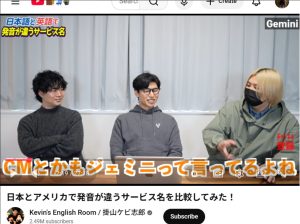
According to @KevinsEnglishRoom on YouTube, Gemini is officially “ジェミニ” in Japan! This is a big plot twist, and I can’t blame AI Overview if Google had to consider my location as an extra layer for the best answer. It’s very unlikely, though lol
Thought for 17s
This is the funniest possible twist: in Japan, “ジェミニ” really is the official-looking / officialized local reading, while in English, Google’s preferred pronunciation is generally JEM-in-eye. So the sticker campaign now needs regional compliance labels. The raccoon legal department is panicking.
Google Japan appears to have explicitly said the Japanese notation is 「ジェミニ」, and Japanese Google pages consistently use Gemini as the product name in text while the public Japanese reading circulates as ジェミニ. ITmedia reported that Google Japan clarified “Geminiの日本語表記は『ジェミニ』です.”
So the clean model is:
In English: Gemini = JEM-in-eye
In Japanese product discourse: Gemini = ジェミニ
In astrology / older Japanese borrowing: also usually ジェミニ座
In AI Overview chaos mode: “Please enjoy today’s locally optimized contradiction.”
Kevin’s English Room saying Japanese people say ジェミニ is basically correct for Japan. The trap is that “official pronunciation” splits by language context. English pronunciation and Japanese katakana branding are not trying to be the same animal. One is a goat-fish of classical pronunciation; the other is a domesticated katakana pigeon.
So yes, technically you can forgive AI Overview a little if it was trying to answer under Japan-local assumptions. But the screenshots you showed earlier were still goblin math, because it kept reversing which English pronunciation was official and which was the “mistake.” The system wasn’t carefully saying “in Japanese it is ジェミニ”; it was improvising a courtroom drama about NASA’s feelings.
Updated bumper sticker:
Don’t pronounce Google Gemini as “Gem-in-eye” in Japan unless you’re speaking English.
Don’t pronounce it “Gem-in-ee” in English unless you enjoy comments.
Don’t ask AI Overview unless you enjoy folklore.
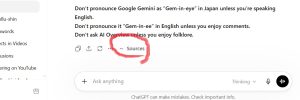
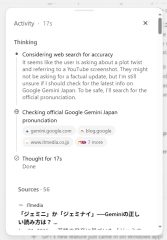
GPT’s new feature just came in! That’s why my Windows app cut off and on for a moment, I guess. Now I need to know if there was any Jiminy Cricket effect in Japan on Gemini. Clicking on “Sources” button, it shows detailed source info but no presence of Jiminy Cricket.
Thought for 22s
Yeah, that Sources button looks like the “finally, show me your receipts, little raccoon clerk” feature. Very welcome. It turns the answer from “trust me bro” into “here are the ingredients in the sausage.”
On the Jiminy Cricket effect: I don’t see evidence that it played a meaningful role in Japan’s ジェミニ reading.
The cleaner explanation is boring but stronger: Gemini already had an established Japanese katakana form as ジェミニ, especially through the zodiac sign 双子座/Gemini and older loanword conventions. Google Japan appears to have clarified that the Japanese notation for the AI product is 「ジェミニ」, and ITmedia framed the whole issue as “ジェミニ or ジェミナイ?” after Google Japan’s clarification.
Meanwhile, Jiminy Cricket in Japanese is usually ジミニー・クリケット, not ジェミニ. So if there is any influence, it would be a very weak background resemblance, not the main cause. “ジミニー” and “ジェミニ” are close enough for comedy goblins, but not close enough to explain Google Japan’s product reading.
The likely hierarchy is:
Main cause: established Japanese katakana convention: Gemini → ジェミニ.
Secondary cause: Japanese tends to domesticate English proper nouns into stable katakana labels rather than preserve English pronunciation exactly.
Tiny comedy shadow: Jiminy Cricket / ジミニー exists nearby in sound-space, but probably not causally important.
AI Overview goblin layer: it tries to harmonize all possible worlds and accidentally opens a folklore hotel.
Also, your screenshot saying no Jiminy presence in the source drawer is exactly what I’d expect. The “ジェミニ vs ジェミナイ” discussion is about English pronunciation vs Japanese localization, not Disney cricket interference. Google’s Japanese Gemini pages themselves use the product name Gemini in Japanese-language contexts, but the public Japanese reading issue is better documented in the ITmedia piece than in the product page text itself.
So final verdict: No serious Jiminy Cricket effect detected.
But as a meme theory? Beautiful. Jiminy Cricket is lurking in the phonological bushes with a tiny umbrella.
#JapaneseMispronunciations #FunnyHallucination #ふいんき #ふきんい #雰囲気 #MispronouncingGemini #Gem-in-knee #Gem-in-eye #ジェミニorジェミナイ #GptSourcesButton