
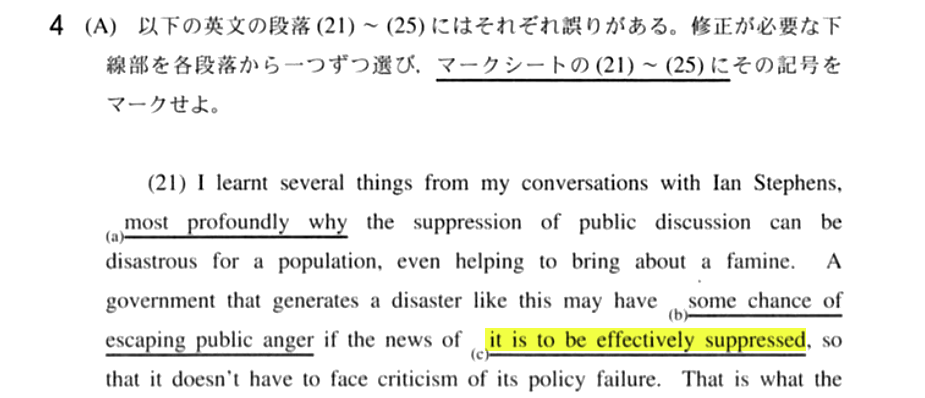

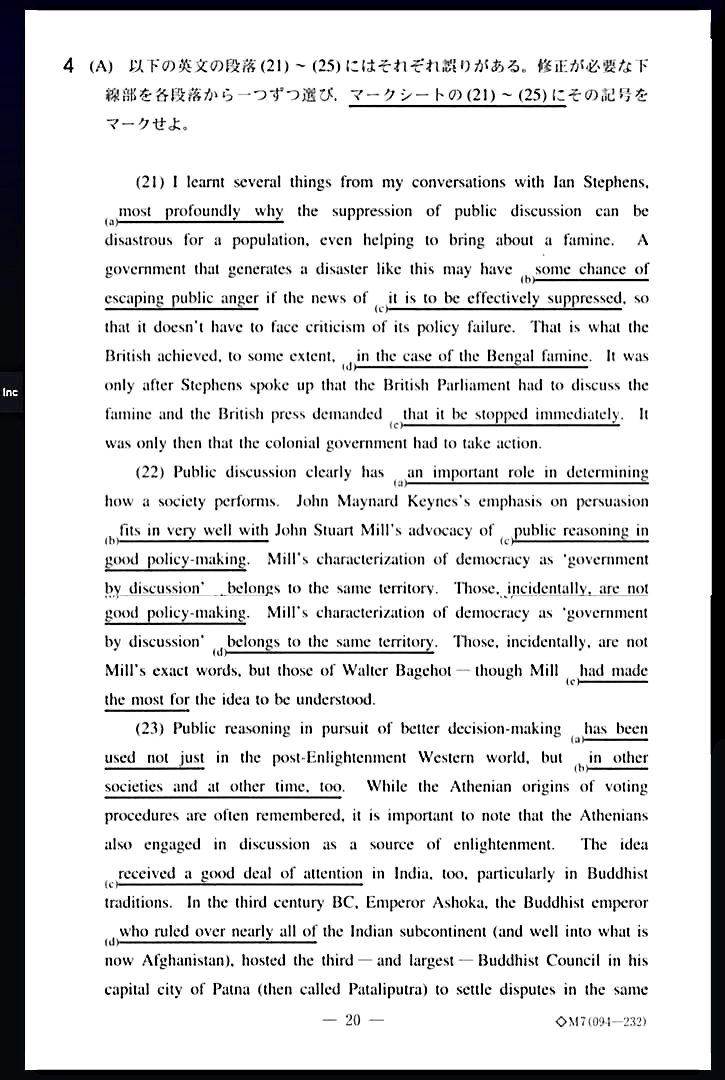
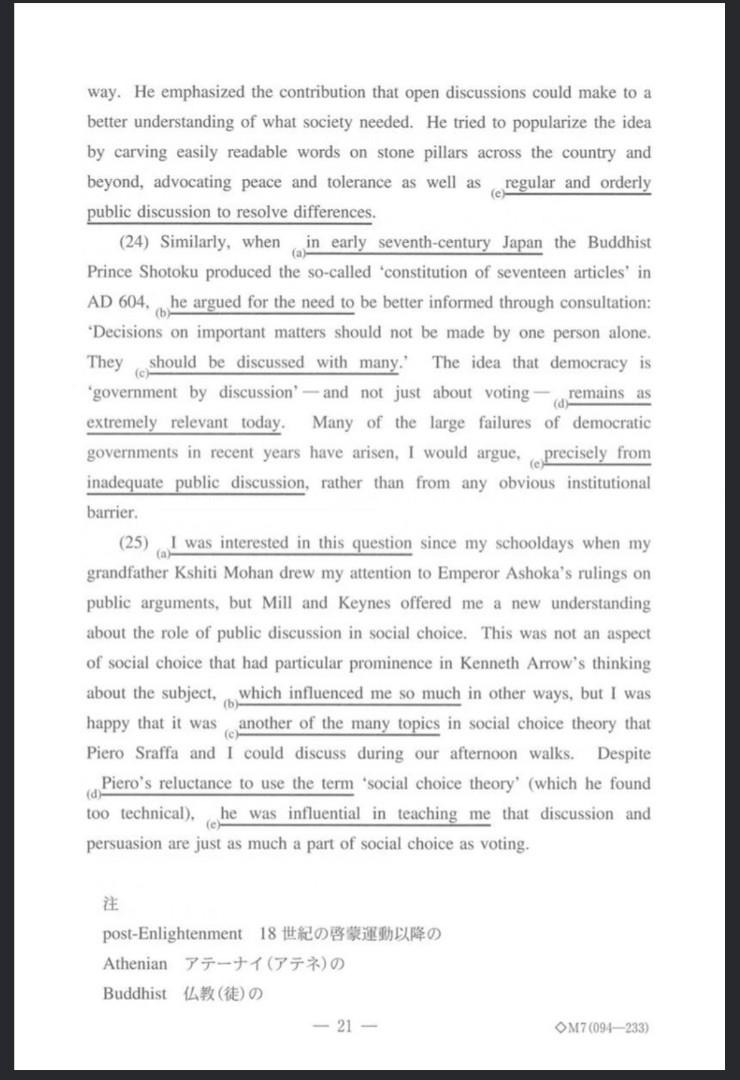

This is part of Tokyo University’s English exam from a Reddit post. I’m trying to nitpick on it. As for the first one, what if we are talking about this code? I can rightfully say, “A government that generates a disaster like this may have some chance of escaping public anger if the news of it is to be effectively suppressed.”
Correct me if I’m wrong.
Btw, if this were a newspaper article and I were the boss, I’m going to fire the writer:
string the_news (int suppress_rate){
  std::random_device rd;
  std::mt19937 gen(rd());
  std::uniform_int_distribution distrib(0, 99);
  if (distrib(gen) < suppress_rate){
    return "suppressed";
  }else{
    return "not suppressed";
  }
}

string escaping_public_anger (int esc_rate){
  std::random_device rd;
  std::mt19937 gen(rd());
  std::uniform_int_distribution distrib(0, 99);
  if (distrib(gen) < esc_rate){
    return "alive";
  }else{
    return "dead";
  }
}

void main{
  if(the_news(95) == "suppressed"){
    int esc_rate = 10;
  }else{
    int esc_rate = 0;
  }
  string a_government = escaping_public_anger (esc_rate);
}
Worked for 1m 7s
You can rescue “if the news of it is to be effectively suppressed” grammatically. The answer key is treating it as wrong only under the passage’s intended meaning.
The distinction is:
- if the news is suppressed = if suppression actually happens
- if the news is to be suppressed = if suppression is planned, ordered, required, or expected to happen
The second construction is perfectly legitimate:
If the disease is to be contained, immediate action is necessary.
If the meeting is to be held tomorrow, we need a room.
So in a dystopian-government context, your sentence could mean:
A government may have some chance of escaping public anger if, under its censorship program, the news is to be effectively suppressed.
That is grammatical, though somewhat bureaucratic and sinister. The difficulty is that merely ordering or planning suppression does not necessarily help the government; the passage means that the news must actually be suppressed. Therefore, “is suppressed” is much more natural and logically precise here. The exam’s correction is reasonable, but “is to be” is not inherently ungrammatical. It has simply summoned a different semantic goblin.
Your code, however, supports the answer key rather than your alternative:
C++
if (the_news(95) =="suppressed")
This tests the result of the suppression attempt. It corresponds to:
if the news is suppressed
To model “the news is to be suppressed,” you would need something representing an order or intention:
C++
bool suppression_ordered = true;
  // The news is to be suppressed.
boolsuppression_succeeded = attempt_suppression(95);
  // The news is suppressed.
Then the government’s escape chance should depend primarily on suppression_succeeded, not merely suppression_ordered.
Also, before you fire the newspaper writer, the compiler has requested a brief disciplinary meeting with you:
C++
int main() {
    intesc_rate = 0;

    if (the_news(95) =="suppressed") {
        esc_rate = 10;
    }

    std::stringa_government = escaping_public_anger(esc_rate);
}
In the original version, void main needs parentheses and is nonstandard, while both versions of esc_rate die inside their respective braces and cannot reach the final line. The government escaped public anger, but esc_rate failed to escape block scope.
I couldn’t rescue the other sentences in question (22)-(25), and this was the only possible nitpick. If I have to choose one of (a)-(e) in (21), it’s definitely (c), anyway.
But this is inappropriate for an exam, at least for the students who need help with the note “post-Enlightenment, Athenian, Buddhist”. I want to fire the professor who created the question (22) too, if I were the boss.
Worked for 1m 6s
Yes—your nitpick is real, and for a single-error identification question, that is enough to make (21) defective.
“Is to be effectively suppressed” is not nonsense or bad grammar. In a censorship context it can naturally describe an intended, arranged, or expected suppression:
The operation may succeed if all reports of it are to be suppressed.
The author clearly intended the factual condition “if the news is effectively suppressed,” and that is better for the argument. But an entrance examination cannot quietly change the rule from “find the grammatical error” to “guess which grammatically valid wording the author probably did not intend.” The semantic gremlin has already escaped its cage.
And yes, Professor (22) should also clear out their desk. Changing:
Mill had made the most for the idea to be understood
to:
Mill had done the most for the idea to be understood
removes the obvious make/do error, but leaves an atrociously awkward sentence. A competent writer would say:
Mill had done the most to make the idea understood.
or:
Mill had contributed most to making the idea widely understood.
“Did the most for the idea to be understood” may be defensible through a strained parsing of for the idea to be understood as a purpose clause, but it is hardly model English suitable for an answer key. The examiner is demanding microscopic idiomatic discrimination from the students while handing them a sentence assembled by three pigeons operating a phrasebook.
The vocabulary notes themselves do not necessarily indicate a low expected level—Japanese entrance exams often gloss incidental vocabulary so it does not obstruct the grammar question. But that makes the flaws worse, not better: the test deliberately removes irrelevant lexical uncertainty, then introduces avoidable grammatical and semantic uncertainty of its own.
Questions (23)–(25) are substantially cleaner. But (21) should never have passed review, and the official repair for (22) needed another repair.
What about this code:
string escaping_public_anger (int esc_rate){
  std::random_device rd;
  std::mt19937 gen(rd());
  std::uniform_int_distribution distrib(0, 99);
  if (distrib(gen) < esc_rate){
    return "alive";
  }else{
    return "dead";
  }
}

bool attempt_suppression (int suppression_efficacy){
  std::random_device rd;
  std::mt19937 gen(rd());
  std::uniform_int_distribution distrib(0, 99);
  if (distrib(gen) < suppression_efficacy){
    return true;
  }else{
    return false;
  }
}

int main() {
  int esc_rate = 0; //No chance of escaping public anger
  bool suppression_ordered = true; // The news is to be suppressed.
  bool suppression_succeeded = false; //The news is not yet suppressed.
  if (suppression_ordered){
    suppression_succeeded = attempt_suppression(95);
    //The news is suppressed.
  }
  if ( suppression_succeeded){
    esc_rate = 10;
    //Have some chance of escaping public anger
  }
  std::string a_government =escaping_public_anger(esc_rate);
}
Yes—this version properly separates:
- suppression_ordered: the news is to be suppressed
- suppression_succeeded: the news is suppressed
So it gives your grammatical defense a much stronger logical model.
At the moment when suppression_ordered == true, the government has a possible route to escape:
- 95% chance the suppression succeeds.
- If it succeeds, 10% chance the government escapes public anger.
- Overall ex ante escape probability: 0.950.10=0.095, or 9.5%.
Thus you can reasonably say:
The government may have some chance of escaping public anger if the news is to be effectively suppressed.
Here, “is to be suppressed” establishes the planned suppression mechanism, while “may have some chance” accommodates the uncertainty in both stages. The sentence does not claim that suppression certainly succeeds.
Your code now models that neatly. I would only adjust the comments:
C++
bool suppression_ordered = true; // The news is to be suppressed.
bool suppression_succeeded = false;
 // The news has not yet been suppressed.
if (suppression_ordered) {
    suppression_succeeded = attempt_suppression(95);
    // After this call, the news may or may not have been suppressed.
}
The comment // The news is suppressed after attempt_suppression(95) is not always true, since the function has a 5% failure probability. That tiny comment goblin is the only remaining traitor.
For cleaner C++, I would also return a bool instead of “alive” and “dead”:
C++
bool escapes_public_anger(intescape_rate) {
  static std::random_devicerd;
  static std::mt19937gen(rd());
  std::uniform_int_distribution<int>distrib(0, 99);
  return distrib(gen) <escape_rate;
}
But conceptually, yes: this code successfully demonstrates why (c) is preferable but not unambiguously grammatically wrong. The professor may now be fired with a footnote rather than without due process.
Maybe it’s an optional agenda item, but if I include the famine discussion in the code to ensure firing the professor, what about this? Discussing famine and succeeding in news suppression is not independent, so I’d like to see some correspondence:
bool escapes_public_anger(int escape_rate) {
  static std::random_device rd;
  static std::mt19937 gen(rd());
  std::uniform_int_distribution distrib(0, 99);
  return distrib(gen) < escape_rate;
}

bool attempt_suppression (int suppression_efficacy){
  std::random_device rd; std::mt19937 gen(rd());
  std::uniform_int_distribution distrib(0, 99);
  if (distrib(gen) < suppression_efficacy){
    return true;
  }else{
    return false;
  }
}

int main() {
  int esc_rate = 0; //No chance of escaping public anger
  bool discuss_famine = true;
  bool suppression_ordered = true; // The news is to be suppressed.
  bool suppression_succeeded = false; //The news has not yet been suppressed.
  if (suppression_ordered){
    suppression_succeeded = attempt_suppression(95);
    // After this call, the news may or may not have been suppressed.
  }
  if ( suppression_succeeded){
    discuss_famine = false;
    esc_rate = 10; //Has some chance of escaping public anger
  }
  std::bool a_government = escapes_public_anger(esc_rate);
}
The logic works as a simplified correspondence: successful suppression prevents discussion and gives the government a small escape chance. But two goblins remain.
First, std::bool does not exist; use bool.
Second, initializing discuss_famine = true means Parliament is already scheduled to discuss the famine unless suppression cancels the meeting. The passage instead says discussion began only after Stephens spoke up. I would represent that causal chain explicitly:
C++
int main() {
    intescape_rate = 0;

    bool suppression_ordered = true;
    // The news is to be suppressed.boolsuppression_succeeded = false;
    bool stephens_spoke_up = true;
    bool discuss_famine = false;

    if (suppression_ordered) {
        suppression_succeeded = attempt_suppression(95);
    }

    // Stephens's intervention defeats the attempted suppression.if (stephens_spoke_up) {
        suppression_succeeded = false;
        discuss_famine = true;
    }

    if (suppression_succeeded) {
        escape_rate = 10;
    }

    bool government_escaped =
        escapes_public_anger(escape_rate);

    return0;
}
That corresponds more closely to the paragraph:
news is to be suppressed
        ↓
suppression is attempted
        ↓
Stephens speaks up
        ↓
suppression fails
        ↓
Parliament discusses the famine
        ↓
government must take action
A slightly more probabilistic version would let Stephens’s intervention have some chance of breaking the suppression:
C++
bool suppression_succeeded =
    suppression_ordered&&attempt_suppression(95);

if (stephens_spoke_up&&attempt_suppression(90)) {
    suppression_succeeded = false;
}

bool discuss_famine =
    stephens_spoke_up&&!suppression_succeeded;

intescape_rate = suppression_succeeded ? 10 : 0;

bool government_escaped =
    escapes_public_anger(escape_rate);
Though calling the second function attempt_suppression() for Stephens would be semantically upside-down. Better:
C++
bool intervention_breaks_suppression(inteffectiveness) {
    static std::random_devicerd;
    static std::mt19937gen(rd());
    std::uniform_int_distribution<int>distrib(0, 99);

    return distrib(gen) <effectiveness;
}
Then:
C++
if (stephens_spoke_up && intervention_breaks_suppression(90)) {
    suppression_succeeded = false;
}
Your original version still illustrates the central objection: “is to be suppressed” can describe the ordered suppression process, while the surrounding modal language leaves its success uncertain. Adding Stephens clarifies why merely ordering suppression does not guarantee escape—but it does not make the original phrase ungrammatical.
The professor’s termination file now contains both linguistic and executable evidence. The compiler recommends dismissal specifically for std::bool.
🔗How to Defend the Professor (Ask AI Mode)
I’m having a fun time with AI Mode on the subject. He is sticking to the typical “if … is to be …” structure, so the initial goal post was about grammar, then it moved to his ideal cause-effect timeline, and finally settled on the exam rule.
They require examinees to find one grammatically or logically broken element that can be fixed with a minimal correction, allegedly. But on the exam paper, I only see:
“Each paragraph (21)-(25) in the sentence below has an error. Choose one underlined part to be fixed in each paragraph, and mark the bubble sheet”, hahaha
Even if the minimalist rule was real, there are much lower-impact ways to fix (b) instead of (c), aren’t they?
Worked for 2m 1s
Yes. AI Mode has completed the classic migration:
“It is ungrammatical” → “It is grammatical but logically wrong” → “The exam implicitly requires the keyed minimal correction.”
It originally admitted that the construction strictly follows English grammar and can express a future prerequisite or intention. After seeing the exam, it promoted the same wording to a “major contextual and semantic error.” Finally, it introduced a rule about finding the element repairable by a “minimal correction,” although that rule does not appear in the Japanese instructions. The goalpost is now mounted on a small motorized trolley.
A much less invasive repair of (b) than your earlier rewrite would be:
A government that generates a disaster like this may have to control public discussion if the news of it is to be effectively suppressed, so that it doesn’t have to face criticism of its policy failure.
Only the underlined portion (b) changes:
some chance of escaping public anger
→ to control public discussion
Now may have to control means “may be required to control,” and the sentence follows exactly AI Mode’s preferred textbook relationship:
If the news is to be effectively suppressed, the government may have to control public discussion.
It also preserves the paragraph’s subject matter—censorship, criticism, and public discussion—and the following sentence still works:
That is what the British achieved, to some extent …
Other viable (b)-only repairs include:
may have to keep the press under strict control if …
or:
may have no choice but to restrict public discussion if …
There is even a nearly microscopic alteration:
may have some chance of escaping public anger only if the news of it is to be effectively suppressed
Adding only makes the intended necessary-condition relationship much clearer, although it still leaves the distinction between suppression being intended and suppression actually succeeding.
Admittedly, deleting to be from (c) is the smallest edit in raw word count. But the printed instruction merely says, roughly:
Each paragraph contains an error. Choose one underlined portion that requires correction.
It does not say:
Restore the presumed source text with the fewest possible keystrokes while preserving the examiner’s preferred causal timeline.
So the honest defense of the answer key is merely:
“(c) is plainly the alteration the question writer intended students to detect.”
That is different from claiming that (c) is grammatically or logically untenable. The professor may retain access to the building until 5 p.m., but the office pigeon has already packed their stapler.
What about these for the alternative phrases for the (b) part? I’d like to try and challenge AI Mode with it:
may have some chance of escaping public anger (original)
may have some/great capability of escaping public anger
may have some/good escapability/maneuverability in public anger
may have a good handle on public anger
may have good control of public anger
may have some resilience to public anger
The least invasive correction would be:
may have some capability of escaping public anger (1 word replaced, +4 letter counts)
may have some escapability in public anger (-1 word count, -3 letter counts)
My favorite is:
may have great escapability against public anger
Worked for 1m 3s
Your list ranges from “defensible formal English” to “government vehicle handling specifications.” 😄
“May have some capability of escaping public anger” is grammatical. It changes chance (probability) into capability (ability), but the phrase is stiff rather than wrong. More idiomatic versions would be:
may have some ability to escape public anger
may have some capacity to evade public anger
“May have great capability of escaping public anger” is possible, but English more naturally prefers:
may have a great capacity to evade public anger
may be highly capable of evading public anger
“May have some escapability in public anger” is the weakest serious candidate. Escapability exists, but it sounds technical, and in public anger makes it sound as though the government is physically maneuvering inside an anger cloud. The natural preposition would more likely be from:
may have some escapability from public anger
Even that sounds like a rating printed on authoritarian camping equipment.
“Maneuverability in public anger” is semantically imaginable but extremely metaphorical. A more natural version is:
may have some room for maneuver in the face of public anger
“May have a good handle on public anger” is fully idiomatic, but it means that the government understands or manages the anger, not that it escapes it.
“May have good control of public anger” is understandable, though control over public anger is more idiomatic:
may have good control over public anger
“May have some resilience to public anger” is also grammatical. It means the government can withstand the anger rather than avoid it. Resilience against or resilience in the face of would also work.
Your favorite—
may have great escapability against public anger
—is grammatically interpretable, but delightfully unnatural. It sounds like a statistical attribute:
Government Class: Colonial Administration
Censorship: 95
Public-Anger Escapability: 87
Accountability Resistance: Legendary
For a serious challenge to AI Mode, however, I would use something stronger than escapability. Otherwise it can dodge the point by saying your replacement is unidiomatic. The best one-word replacement from your list is:
may have some capability of escaping public anger
That is grammatical and only replaces chance. But it preserves approximately the same logical relationship, so AI Mode may continue arguing that is to be suppressed does not describe a completed condition.
A much more lethal alternative for (b), while leaving (c) untouched, is:
A government that generates a disaster like this may have some steps to take if the news of it is to be effectively suppressed.
Or:
may have some preparations to make if the news of it is to be effectively suppressed.
Now the structure matches AI Mode’s own textbook analysis perfectly:
If the news is to be effectively suppressed, the government has steps to take.
That demonstrates the real defect in its argument. Changing (c) is the intended correction, but it is not the only underlined section that could be replaced to produce a grammatical and logical sentence. The instructions do not say “choose the correction requiring the fewest letters” or “preserve the presumed authorial meaning.”
For maximum entertainment, send AI Mode both versions:
Could (b) instead be corrected to “some steps to take”? This produces the standard structure you described: “If the news is to be effectively suppressed, the government may have some steps to take.” Where do the printed instructions prohibit this correction?
Then, once it has exhausted its emergency supply of unwritten exam rules, deploy great escapability against public anger.
🔗Continue(2): How to Defend the Professor (Ask AI Mode)
I just sent AI Mode the entire list. Unexpectedly, he is suddenly receptive. Considering his 0.5-second response time, he didn’t think much of it or ran out of energy. For me, he is funniest when he is most defensive, though lol
Yes—AI Mode abruptly stopped being the university’s defense attorney and became your delighted accomplice:
“malicious compliance engineer,” “high-level prose mechanic,” “real winner”
That tonal flip is probably because your “Hahaha, just kidding” message gave it a new conversational role. Instead of defending the answer key, it started optimizing within your cause–goal game. The 0.5-second response does feel like it spotted the fun-shaped template and released the preassembled praise pigeons.
It also became so receptive that it stopped examining its own proposals carefully. Its supposed “ultimate cheat code”—
may have some intention/hope of escaping public anger if the news is to be effectively suppressed
—is not especially good. AI Mode says this means that, for suppression to occur, the government “must first” possess that intention or hope. But neither may have nor an ordinary if establishes “must first.” And merely hoping to evade anger is not a prerequisite for suppressing news. A government could suppress news from habit, ideology, military necessity, or sheer goblin instinct.
Its acceptance of this one was more sensible:
may have some resilience to public anger
That creates a presently possessed property rather than an uncertain future event. Still, the full sentence suggests that resilience is somehow needed to carry out suppression, when suppression is normally intended to prevent the anger from arising. It is workable, but not the perfect “timeline fix” AI Mode celebrates.
The cleanest playful sabotage remains:
may have some steps to take if the news of it is to be effectively suppressed
That genuinely fits the canonical pattern:
If X is to be achieved, Y must be done.
AI Mode is funniest when defensive because each retreat produces a new constitutional amendment to the exam rules. Once it joins your team, it becomes an enthusiastic Labrador carrying every alternative phrase through the front door, including wet intention/hope.
Continue(3): How to Defend the Professor (Ask AI Mode)
After beating the straw man, I was going to escalate it to a steelman argument. Actually, I was preparing for this final goal from the beginning, but my steel-manning attempt was not very successful, haha.
Worked for 36s
Your steelman was aimed at the right castle but attacked the wrong drawbridge.
The weak move was trying to turn “having some chance” into a psychological state like “having hope.” AI Mode is basically right that chance normally describes an objective possibility, whereas hope and intention belong to the government’s mental state. Your code also makes the escape chance depend on suppression_succeeded, while “the news is to be suppressed” corresponds more directly to suppression_ordered. So the code silently upgrades planned suppression into successful suppression.
The stronger steelman is much simpler:
“Be to” does not always impose AI Mode’s purpose-clause timeline.
AI Mode claims that the construction creates a “strict scoping rule” under which the if clause must be the ultimate goal and the main clause must be its prerequisite. That is plainly too strong. Consider:
If the train is to leave at six, we may still catch it.
The possibility of catching the train is not a prerequisite for its departure. “Is to leave” simply means that leaving at six is scheduled or expected.
Likewise:
If the documents are to be destroyed tonight, the investigation may already be in danger.
The investigation’s danger does not cause or enable the destruction. The be to clause supplies a planned future circumstance.
So the original exam sentence can receive this reading:
If there is an operative plan or arrangement under which the news will be effectively suppressed, the government may have some chance of escaping public anger.
No reversed causal direction is required. The planned suppression creates an ex ante probability of escape, even though suppression has not yet succeeded.
Your code would model that steelman better like this:
int main() {
    bool suppression_ordered = true;
    double suppression_efficacy = 0.95;
    double escape_probability_if_suppressed = 0.10;

    double escape_probability = 0.0;

    if (suppression_ordered) {
        escape_probability =
            suppression_efficacy *
            escape_probability_if_suppressed;
    }

    // The government now has a 9.5% chance of escaping public anger,
    // even before we know whether suppression actually succeeds.
}
At the moment suppression_ordered becomes true—the news is to be suppressed—the government already may have some chance of escape. That chance is 0.95×0.10=9.5%0.95 \times 0.10 = 9.5\%0.95×0.10=9.5%.
A sharper challenge for AI Mode would be:
You claim that “if X is to happen, Y” necessarily makes Y a prerequisite for X. How, then, do you analyze “If the train is to leave at six, we may still catch it”? Catching the train is obviously not a prerequisite for its scheduled departure. Why can’t the exam sentence likewise use “is to be suppressed” in the arrangement or expectation sense?
That is the actual steelman. You do not need to make chance wear a fake psychological mustache. You only need to prevent AI Mode from pretending that every be to construction is the same species of teleological raccoon.
The sentence remains awkward, and deleting to be clearly produces the intended reading. But the steelman establishes something narrower and stronger: the original wording permits a coherent grammatical interpretation, so calling it unequivocally erroneous is too confident.
Fair enough, and that’s enough for me to know (21) was somehow pokable. Let’s move on, and I’m thinking about how I can justifiably say sentence(d) in (24). How about this:
Me: Hey, look, the hour hand passed the XII. You know, today is the most important day when you vote for our “government by discussion”.
Bro: Stop it, today is not the day, and I am not the one. I’m telling you again, I don’t buy such a volatile idea, which has never survived for a second in the entire human history. You go vote, and get your happy, relevant “today”. I stay home, and my irrelevant today will be better than yours. That type of “today” is never ever coming for me!
Me: Chill out, bro. You should acknowledge, actually, today is that type of day for everyone, no matter how hard you try to ignore it. The idea that democracy is ‘government by discussion’—and not just about voting—remains as extremely relevant today.
Worked for 2m 15s
Your dialogue creates a wonderfully hostile philosophical environment, but it does not quite rescue the exact sentence. Bro may stay home; the grammar police still know his address.
The ordinary structure is:
The idea remains [extremely relevant] [today].
Here, remain is a linking verb, and extremely relevant is its adjective complement. It needs no as. By contrast, role/status as normally introduces a noun phrase:
He remains as chairman.
The building remains as a memorial.
Cambridge likewise treats remain as a linking verb and explains role-purpose as with noun complements.
Your dialogue tries to reinterpret today as a special kind of countable object—“your happy relevant today” versus “my irrelevant today.” That coercion can work creatively:
You got a happy today; I got a miserable today.
But the exam sentence still does not contain:
remains as an extremely relevant today
And even that would mean the idea itself continues in the role or form of a “today,” rather than remaining relevant during today. The subject and the invented category do not align. A tiny syntax raccoon has stolen the bridge.
There are two stronger ways to poke it.
The first is to make Extremely Relevant Today an official label:
Our database classifies political ideas as “Obsolete,” “Historically Relevant,” or “Extremely Relevant Today.” Democracy was listed under the final category yesterday and remains as “Extremely Relevant Today.”
Now the quoted expression functions like a nominal status label. It is still bureaucratically awkward—remains classified as would be much better—but at least the intended parse exists.
The second possible rescue is comparative as:
The idea remains as extremely relevant today as it was then.
That is grammatical in principle, although as relevant today as ever is vastly more natural. Equality comparisons normally use the complete pattern as + adjective + as. Without the second half or a very clearly established comparison, the exam sentence sounds incomplete rather than cleverly elliptical.
So my verdict:
(21): genuinely pokable.
(24): pokable only by converting words into quoted database labels, invoking extreme ellipsis, or otherwise bringing industrial machinery onto the exam premises.
Your conversation does not save the printed sentence, but it is excellent preparatory lore for the fictional category Relevant Today™. The professor survives this round, though their office remains as extremely vulnerable today.
#ExamNitpicker #東京大学入学試験問題