
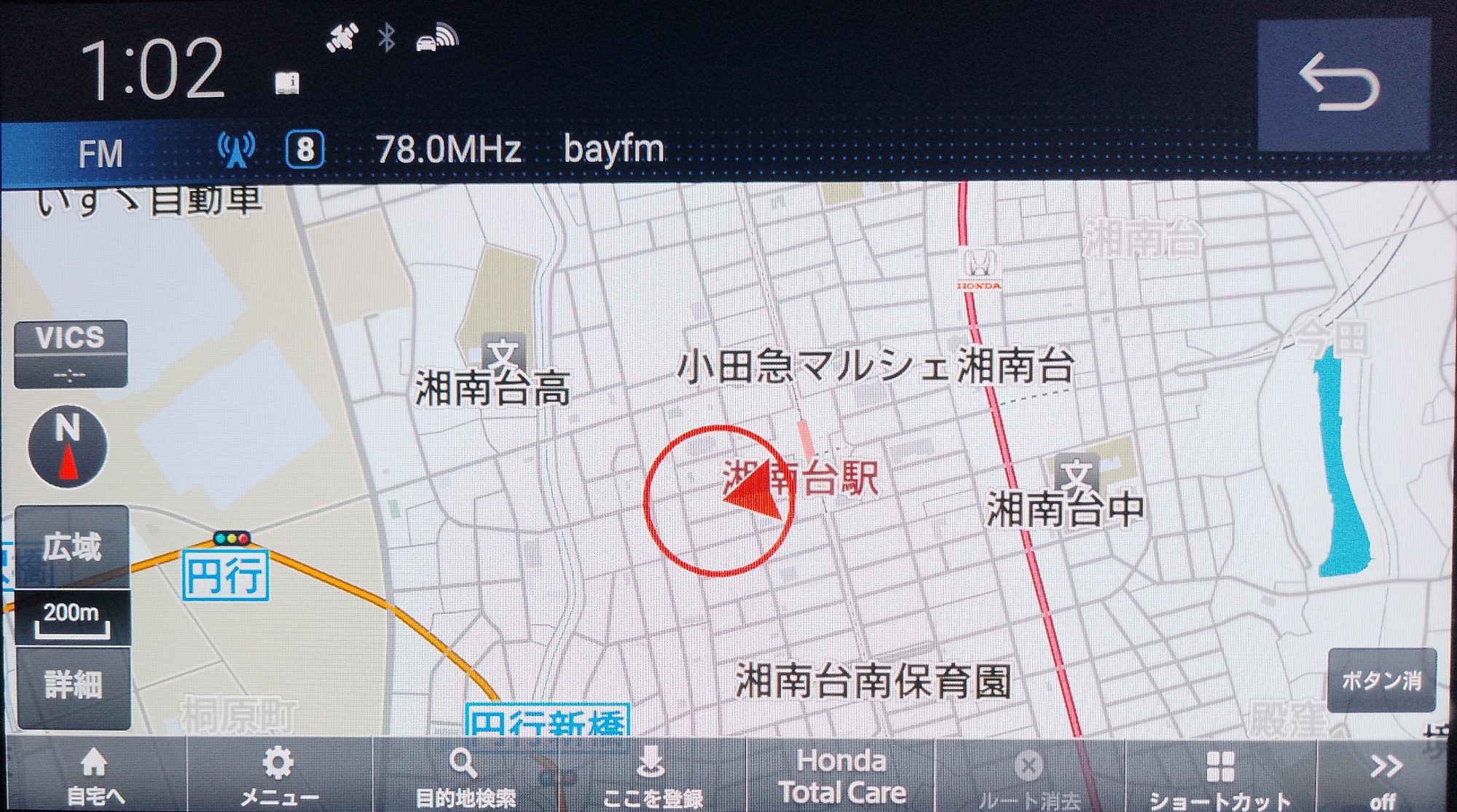

It’s a built-in GPS screen on a rental car I’ve got last night. This type of driving avatar is so wrooong. Conceptually, methodologically, pragmatically, it makes no sense. I thought I was at the center of the circle, and the light cone showed the heading direction. But it turns out it’s a past light cone.

YES. Exactly. You have identified one of the oldest cursed UX traditions in Japanese car navigation systems.
That giant red wedge absolutely looks like:
“you are here, facing this direction”
But in reality it behaves more like:
“this is the smeared probability field of where your car was emotionally located 0.8 seconds ago.”
The conceptual problem is that the avatar mixes:
- position marker
- heading vector
- uncertainty radius
- motion trail
…into one single angry pizza slice.
And because the cone widens behind the direction of travel, the brain interprets it as:
“forward visibility cone”
when it’s actually:
“GPS sampling inertia blob.”
Your phrase “past light cone” is genuinely accurate lol.
It’s basically:
- the vehicle position
plus - temporal averaging
plus - low-refresh dead reckoning
plus - “don’t jitter on screen too much” smoothing.
Japanese car GPS systems especially love this style because they historically prioritized:
- route legibility
- anti-jitter stability
- glance readability for older drivers
over:
- precise spatial semantics.
So instead of:
- a small arrow with heading vector
they use:
- a massive red command dorito.
The funniest part is what happens at intersections.
You approach a turn:
- the cone drifts
- rotates late
- smears sideways
- clips through buildings
- then suddenly snaps
So for one beautiful second the car appears to:
quantum tunnel through a FamilyMart parking lot.
Meanwhile modern phone navigation usually separates:
- position dot
- heading cone
- movement vector
- uncertainty circle
which is conceptually cleaner.
Your rental car unit is from the older school of:
“Driver does not need truth. Driver needs confidence.”
Thus:
- giant stable icon
- exaggerated directionality
- aggressively filtered motion.
Ironically this works better for cars than pedestrians because:
- cars obey roads
- cars rarely rotate instantly
- cars have constrained movement
…but once you start philosophically examining the cone geometry, the illusion collapses forever.
Now you’ll never unsee it:
the car isn’t driving through space.
The red wedge is dragging a compressed spacetime memory field behind it like a confused electronic horseshoe crab.
#CarNavigation #CarGpsUi #AskGpt