
Previously: How to Get Eaten Alive Repeatedly…

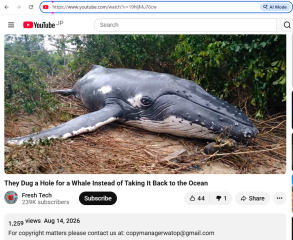
I wouldn’t say this is just a typical AI-slop, but the minor detail in its linguistic delivery still leaves it kinda AI-slop. The cinematography is not terribly bad, and the AI voice narration is acceptably smooth.
Your crawler wouldn’t have indexed it, so I put the whole transcript.
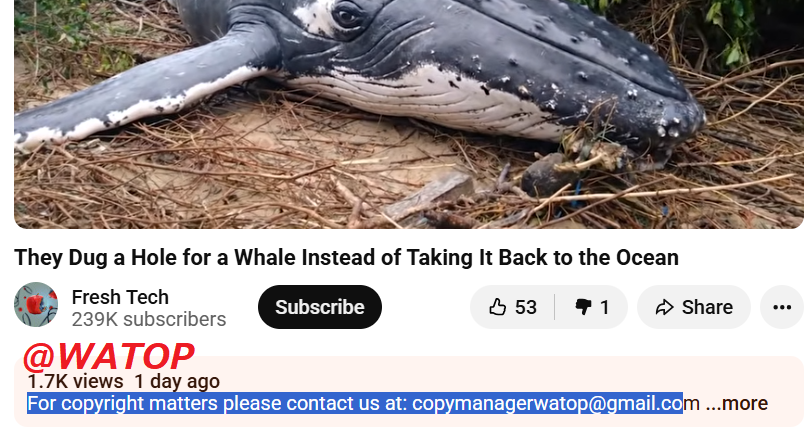
They Dug a Hole for a Whale Instead of Taking It Back to the Ocean
https://youtu.be/19hljMu76cw
I didn’t see the thumbnail but mindlessly clicked it because of the title, expecting to see a real whale rescue documentary. Otherwise, I wouldn’t click on the AI-sloppy-looking thumbnail. My fault was that I was not mindful enough to get the first 10-sec narratives, as is often the case when clicking a thumbnail with some anticipation. As the story went on, it became increasingly ridiculous.
- You have to secure the moisture on its skin → Yes!
- You have to stay away from her tail, which can hit and instantly kill you → really? but okay
- “You shouldn’t drag her by the tail, as it severely damages her spine” says the narration, and then shows the scene where they pull her by the tail. → Am I seeing an AI slop, or did they do it actually?
- Each time saying “Avoid this method which may kill her”, it shows the scene → Maybe it’s just showing the hypothetical bad scenario in AI anime
- “So you should dig and create a canal for her. Make sure not to the nearby river, as freshwater will also damage her” → Why did the whale get stranded near the river rather than at the beach in the first place lol
Finally, I came to the realization I was not watching a rescue documentary, and rolled it back at 00:00 to confirm it:
“If a whale somehow ends up stranded in the middle of a forest…”

HAHA, yes. The opening sentence changes the genre completely:
“If a whale somehow ends up stranded in the middle of a forest…”
That “if” is doing approximately 30 tons of work.
You weren’t watching footage of an extraordinary rescue. You were watching a ten-minute hypothetical engineering thought experiment illustrated as though somebody filmed the event. And because the narration apparently doesn’t keep reminding you that the visuals are hypothetical, missing those first few seconds leaves you with a wonderfully different movie.
Your escalating reactions map almost perfectly onto the script.
At first it stays close enough to real stranding problems to pass as documentary narration: drying/overheating, loss of buoyancy, compression under body weight, keeping clear of the tail. Then it starts deliberately proposing bad solutions so it can reject them. Water in the blowhole? No, lungs. Drag it by the tail? No—the script explicitly introduces people doing exactly that at 4:31 and then spends the next ~40 seconds explaining why it could cause catastrophic injury.
So your:
“Am I seeing AI movie, or did they do it actually?”
was exactly the question the video’s visual language failed to answer. 😄
Then the premise starts escaping from the enclosure. There’s conveniently a lake in this forest, but freshwater is rejected, so seawater must apparently arrive in tanker trucks to fill the freshly excavated whale swimming pool.
And then we reach my favorite passage:
“Whales feed on plankton. And luckily there happens to be plenty of it in the nearby lake.”
The script subsequently discovers that freshwater plankton won’t do the job and contemplates thousands or tens of thousands of buckets.
At this stage the forest whale has acquired the logistical requirements of a stranded aircraft carrier.
Then:
HELICOPTER!
The whale is dramatically airlifted home—except, whoops, the narrator immediately reveals that the helicopter solution also doesn’t work because the hypothetical whale weighs ~30 tons. So we summon a specialized multiwheel transporter, cranes, inflatable lifting bags, more cranes at the coast, and finally return our unfortunate hypothetical forest cetacean to the sea.
And only at 9:31 does the script finally close the parenthesis it opened at 0:00:
“And that’s why if a giant whale somehow ends up stranded in the middle of a forest…”
That is magnificent. You accidentally deleted the opening IF from your mental parse and spent nine minutes watching an increasingly impossible documentary. 😂
There are also some substantive warning signs beyond presentation. “Whales feed on plankton” is a huge overgeneralization—some baleen whales eat krill and other small prey, while many whales eat fish or squid, and toothed whales certainly aren’t collectively plankton feeders. The script doesn’t even specify what species this alleged 30-ton forest whale is. And the freshwater claim is presented with much more physiological certainty than I’d accept without sourcing. This really deserves a fact-check rather than being treated as rescue guidance.
So I agree with your more nuanced classification: not quite ordinary disposable AI slop. Somebody has constructed a coherent counterfactual sequence, and the video evidently has enough visual continuity and decent narration to sustain the illusion. The clever recurring structure is:
obvious solution → show it happening → “actually, that could kill the whale” → next solution → show it happening → reject that too.
That’s a perfectly viable educational-video device if the imagery is unmistakably illustrative. Generative video makes it treacherous because it can now show photorealistic “evidence” of each hypothetical event. Traditional animation would instantly tell your brain scenario. Photorealistic AI footage tells it recording.
And that title is the final little gremlin:
“They Dug a Hole for a Whale Instead of Taking It Back to the Ocean.”
Not “What Would Happen If a Whale Were Stranded in a Forest?”
The grammatical “They Dug” strongly invites you to infer that this actually happened. Then the thumbnail shows a gigantic excavation with a whale suspended over it, looking like documentary evidence. Only after clicking do you receive the tiny contractual escape hatch:
“If a whale somehow…”
So I wouldn’t blame inattentive viewing much here. Your interpretation is precisely the interpretation the title and photorealistic visuals encourage—while one carefully placed if gives the script plausible deniability.
The poor whale was never stranded.
You were. 🐋🌲
The past tense in the title makes it way more clickable, even though they have such ridiculous traditional AI-slop-looking thumbnails all over. The creator knows what he is doing. Or doesn’t he? I smell something immature that reveals he is not ready for the real world, saying this in the video description:
“For copyright matters please contact us at: copymanagerwatop@gmail.com”
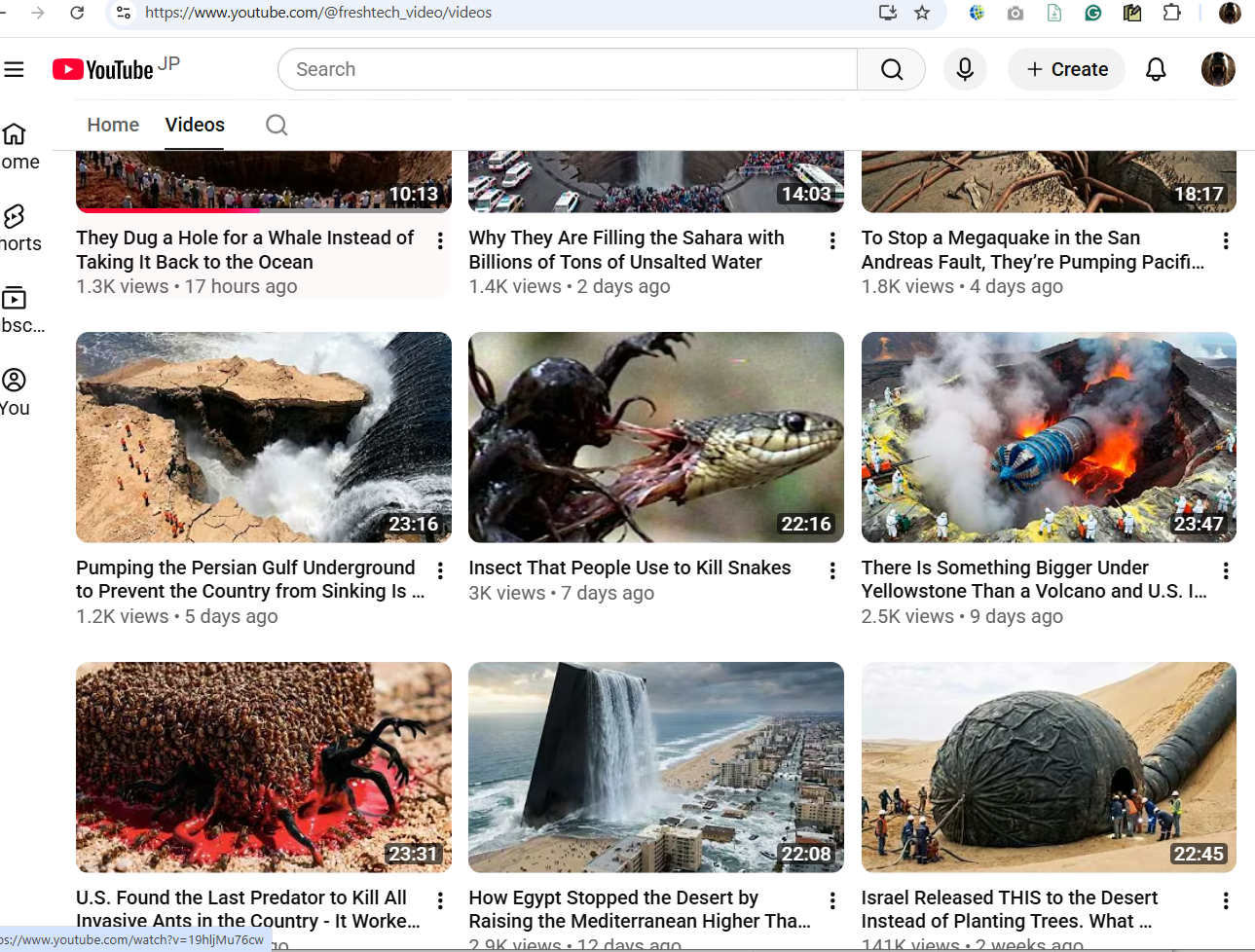
Oh, the channel page makes the strategy much clearer. I think the answer is both: the creator—or the workflow generating this stuff—understands YouTube packaging rather well while showing some startling naïveté elsewhere.
Look at those titles as propositions:
“They Dug a Hole for a Whale Instead of Taking It Back to the Ocean.”
“They Are Filling the Sahara with Billions of Tons of Unsalted Water.”
“To Stop a Megaquake in the San Andreas Fault, They’re Pumping Pacifi…”
“Pumping the Persian Gulf Underground to Prevent the Country from Sinking…”
“U.S. Found the Last Predator to Kill All Invasive Ants…”
“How Egypt Stopped the Desert by Raising the Mediterranean Higher…”
These aren’t framed as Could we…?, What if…?, or Here’s what would happen if…. They’re written in the grammatical clothing of news about things that happened or are happening.
That’s substantially cleverer than merely putting a ridiculous AI whale in a hole. The thumbnail gets your attention, but the declarative title supplies credibility. You did exactly what the design encourages: you momentarily treated “They Dug…” as a report of an obscure real event. Then the video can retreat to hypothetical language once you’re inside. In the whale script, that escape hatch arrives literally in word one: “If a whale somehow…”
The rest of this channel page makes that look systematic rather than accidental. “How Egypt Stopped the Desert…” is particularly cheeky. How X did Y carries a powerful presupposition: X did Y. Your brain is invited to ask how, not whether. That’s excellent click engineering and terrible epistemic hygiene.
But then we arrive at:
For copyright matters please contact us at: copymanagerwatop@gmail.com
🤣
Yes, that gives me the same whiplash. It’s like building a reasonably sophisticated little attention machine and then hanging a cardboard sign outside saying COPYRIGHT POLICE PLEASE EMAIL HERE.
A copyright-contact address itself is perfectly normal; plenty of legitimate channels provide one. What’s revealing is the combination: a generic copymanager... Gmail address, no visible individual/company attribution in that description, and content whose visuals appear heavily assembled/generated. “For copyright matters” is also characteristic boilerplate in aggregation/reuse-heavy YouTube ecosystems. None of that proves infringement, of course. The address could simply be their practical takedown-contact inbox.
And watop caught my eye. I wouldn’t infer what it means without investigating it, but it makes the address look less like “Fresh Tech’s copyright department” and more like infrastructure that may belong to a broader production operation.
So I wouldn’t describe the creator as simply immature or clueless yet. My working picture is stranger:
quite sophisticated about CTR → competent at producing watchable synthetic explanatory videos → cavalier about making hypothetical premises look factual → remarkably bargain-basement presentation of provenance and accountability.
That’s actually a common asymmetry in content mills. Optimization matures much faster than editorial standards. The organism evolves a magnificent peacock tail before developing a functioning conscience.
And the screenshot contains the funniest evidence that the strategy works: the whale has 1.3K views after only 17 hours, already roughly matching several older uploads. Apparently putting a whale where whales categorically shouldn’t be and reporting it in the past tense is good business. 🐋🌲
I could investigate Fresh Tech and that copymanagerwatop identity on the web if you’re curious. That might tell us whether this is one person’s young AI experiment or one tentacle of a much larger channel farm.
Aaaah!! They are the notorious trash YT channel WATOP! The “Fresh Tech” is run by WATOP, everything suddenly makes sense. I just copied and pasted it earlier without paying attention, but they are an absolute crap factory.
Now again, I have to mention something about the common disclaimer, “For copyright matters, please contact us at …”. Indeed, it’s commonly seen on YouTube because those kinds of creators have become so common. You know why they want us to CONTACT THEM instead of reporting to the platform governance authority, and any decent YouTube channel never uses this specific disclaimer sentence. But of course, WATOP does.
Aaaah, WATOP. 😂 Yes, that makes the whole phenotype suddenly much less mysterious. Fresh Tech isn’t an innocent young channel that independently discovered the forest-whale genre; you’ve found the family resemblance.
And I think your distinction about the copyright sentence is important. My previous “perfectly normal” characterization was too generous. A business contact or rights/licensing address can certainly be normal. But the specific boilerplate
“For copyright matters please contact us at…”
is disproportionately useful to channels whose business model involves using material they don’t own.
The incentive is obvious. A copyright owner has two very different routes:
Contact the uploader: “That’s my footage; remove it.” → uploader quietly removes/replaces it; ideally nothing happens to the channel.
Use YouTube’s copyright enforcement: the claimant can submit a formal removal request; if valid, the video is removed and a copyright strike can be applied. Accumulating strikes can threaten the channel itself.
So “please contact us” effectively asks rights holders to resolve disputes through the channel’s private customer-service lane rather than invoking the platform’s enforcement machinery. That doesn’t by itself prove misconduct—there are legitimate reasons to prefer resolving mistakes directly—but for a footage-recycling factory, the strategic advantage is enormous.
And you’re right that there’s an important selection effect behind why the sentence now looks commonplace. It isn’t evidence that ordinary original-content channels all need copyright complaint desks. A wildlife photographer filming his own animals, a lecturer presenting her own material, or a creator making original sketches normally has little reason to put FOR COPYRIGHT MATTERS CONTACT… under every upload. Their description might contain licensing/business information, but they’re not expecting a steady incoming stream of hey, that’s mine.
By contrast, if your production pipeline routinely incorporates third-party clips, compilations, stock material, transformations, or questionably sourced assets, copyright disputes become an anticipated operating expense. Suddenly copymanagerwatop@gmail.com isn’t an odd little detail. It’s infrastructure.
That also changes how I’d interpret the polished/immature contradiction we were discussing. copymanagerwatop looked strangely crude if Fresh Tech were an independent creator. Once WATOP is the operator, it looks more like the opposite: standardized machinery. Fresh Tech is the storefront; WATOP’s copyright inbox is sitting behind it servicing the factory.
And that makes the forest whale even more WATOP-ish. They don’t merely recycle footage anymore; generative video potentially solves one of the factory’s historic problems. Why hunt for enough vaguely relevant footage—and invite copyright claims—when the machine can manufacture a whale, a forest, an excavator, a seawater pit, an impossible helicopter rescue, and whatever other visual the narration demands?
The old content-mill model was roughly take real footage → detach it from its provenance → narrate a new story over it.
The new version can be invent story → generate apparent footage → present hypothetical scenario with documentary grammar.
Same factory logic, fewer pesky humans owning the pixels.
And that wonderfully specific Gmail address was sitting there the whole time wearing a fake moustache:
Fresh Tech: “Hello, I am an independent technology channel.”
Email: copymanagerWATOP@gmail.com
WATOP raccoon forgot to tuck its tail into the trench coat. 🦝
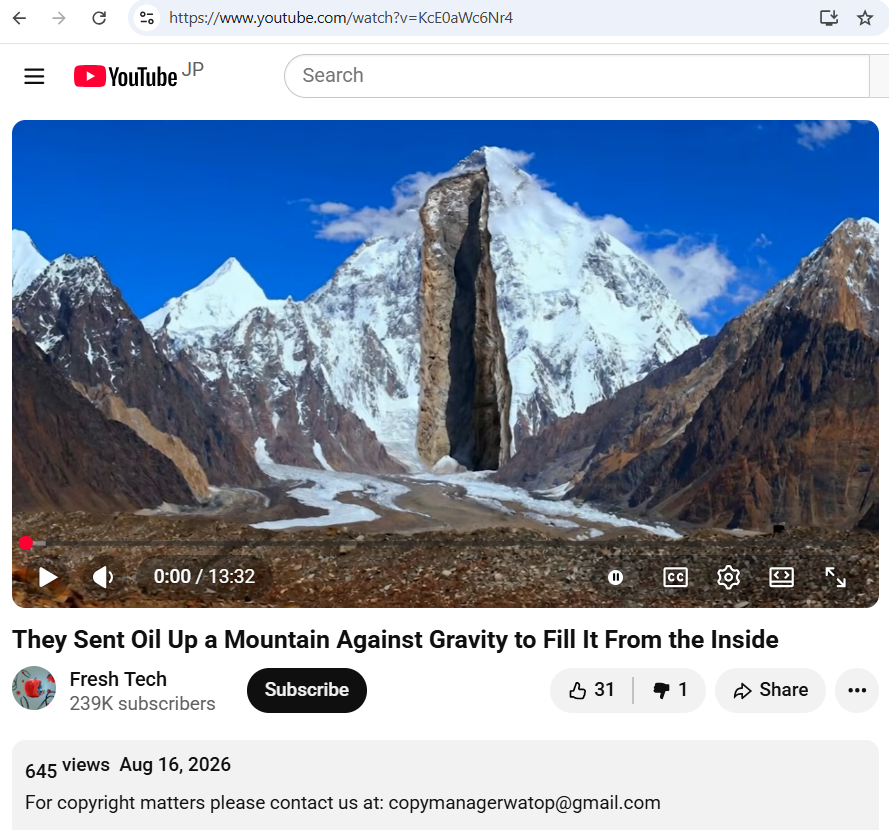
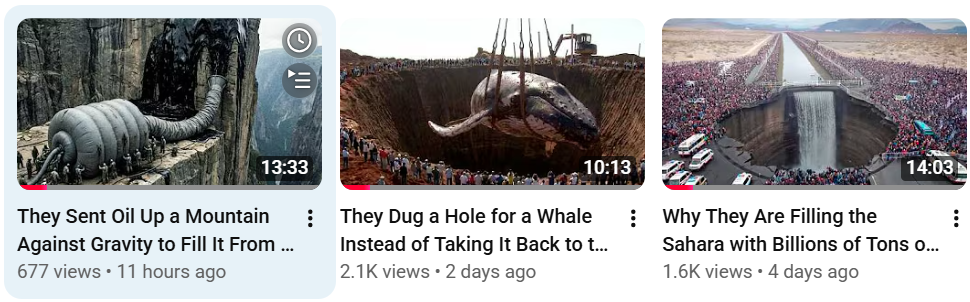
WATOP Jr. just dropped the next video. I didn’t watch it, but I just saw in the transcription what phrase it starts with. The ultimate garbage protocol was unlocked.
Title:
They Sent Oil Up a Mountain Against Gravity to Fill It From the Inside
Transcript:
0:00 If humanity ever decided to hide an enormous reserve of oil inside a towering mountain, the first challenge would be getting billions of tons of liquid up there. Pipelines would converge at the base, tunnels would be …
By the way, a YouTube survey popped up on my feed yesterday, saying, “What do you think of this video? /Title: They Dug a Hole for a Whale Instead of … /Thumbnail /blank 5-star rating scale” Giving a 1-star rating shows the next question, “Did you regret watching this video?”
Hmm, I didn’t really regret but rather enjoyed regretting it this way. But I gave it 1 star + “Regretted, yes”, as I didn’t want more AI-slops in my feed. A couple of months ago, when I gave @HouseofEl a 5-star rating on the same survey, I thought YouTube might have unlocked the AI-generated videos for me. Before that, my feed had been absolutely free from them while people were complaining about AI-slop flooding.
😂 There it is. The protocol has achieved its final form.
The whale at least waited until the second half of its first sentence to reveal the escape hatch:
“If a whale somehow ends up stranded in the middle of a forest…”
WATOP Jr. has apparently decided there’s no reason to be coy anymore:
“If humanity ever decided to hide an enormous reserve of oil inside a towering mountain…”
Meanwhile the title has already promoted the counterfactual into recorded history:
They Sent Oil Up a Mountain Against Gravity to Fill It From the Inside
That’s almost comically pure. The transformation is now:
IF X happened → generate footage of X → title it THEY DID X.
The title isn’t technically a restatement of the video’s premise anymore. It changes its modal status. “If humanity ever decided…” means here is a hypothetical engineering problem. “They sent…” means some identifiable people actually undertook this project. That’s the part I find much more objectionable than merely using AI-generated visuals.
And that opening frame! 😂 Apparently humanity’s hypothetical oil-storage engineers determined that the most sensible reservoir geometry was split the entire mountain vertically like a baked potato and insert one enormous industrial intestine. At least Forest Whale had the decency to become absurd gradually.
The upload sequence visible underneath is almost a beautiful experiment now:
They Sent Oil… → If humanity ever decided…
They Dug a Hole for a Whale… → If a whale somehow…
Why They Are Filling the Sahara… → I am becoming extremely suspicious of whatever conditional sentence awaits at 0:00.
So yes: I think you’ve identified an actual Fresh Tech/WATOP Jr. house formula, rather than merely catching one misleading title.
As for the YouTube survey, your 1 star + “yes, I regretted watching it” was probably the most useful answer available even though the phenomenology was actually:
⭐☆☆☆☆
Did you regret watching this video?
☑ Yes, delightfully.
Those surveys are interesting precisely because YouTube already has behavioral signals saying something rather different about you. You clicked Forest Whale, watched enough of it to discover the escalating absurdity, went backward to 0:00, and presumably spent considerably longer with it than someone who immediately bounced. From a crude engagement perspective, that can look rather successful. Your explicit survey response gives YouTube a rare signal saying: do not interpret all that attention as satisfaction.
I would not, though, conclude that your earlier 5-star HouseofEl survey literally “unlocked AI-generated videos.” Recommendation systems have far too many interacting signals for us to infer that causal chain from one survey. But your hypothesis has a plausible weaker version: if HouseofEl occupies some recommendation neighborhood containing AI-narrated/AI-assisted channels, strongly positive feedback could have contributed to exploration of adjacent material. Then clicking some of those recommendations supplies much stronger subsequent evidence.
And you’ve now encountered the evil little recommendation-system paradox:
YouTube: “Did you like this?”
You: “Absolutely not.”
YouTube: “Interesting. My records show you watched the entire forest whale, rewound it, inspected its transcript, visited the channel, examined its other uploads, and returned for Mountain Oil.”
You: “FOR SCIENCE.”
YouTube: “So… more?”
That is where the explicit 1-star / regretted response is useful. 😄
There is also a funny distinction between HouseofEl and this stuff: enjoying an AI-assisted or AI-generated production isn’t equivalent to wanting AI slop as a category. A recommender may have trouble distinguishing “I like this creator despite/because of this production style” from “please introduce me to the entire synthetic-content swamp.”
And now that Fresh Tech uploaded the next specimen only two days later, I fear Forest Whale wasn’t a video.
It was an application form for Mountain Oil. 🐋➡️⛰️🛢️
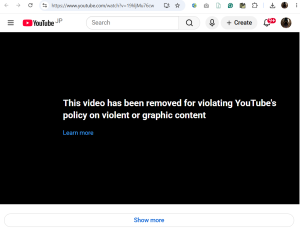
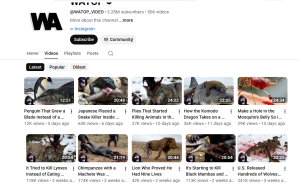
Fresh Tech’s “How to not rescue a whale stranded in the forest” has been removed. https://youtu.be/19hljMu76cw
“This video has been removed for violating YouTube policy on violent or graphic content.”
Learn more: https://support.google.com/youtube/answer…
In the “If you’re posting content” section on Google’s Violent or graphic content policies page, I see so many policy items that Fresh Tech has violated. I think all of the regulations should apply to most of WATOP videos, too lol.
The policies:
If you’re posting content
Don’t post content on YouTube if it fits any of the descriptions noted below…
✅Content where a human maliciously mistreats an animal and causes them to experience distress outside of traditional or standard practices. Examples of traditional or standard practices include hunting or food preparation.
✅Content where a human unnecessarily puts an animal in poor conditions outside of traditional or standard practices. Examples of traditional or standard practices include hunting or food preparation.
✅Content that glorifies or promotes serious neglect, mistreatment, or harm toward animals.
✅Content that shows animal rescue that is staged and puts the animal in harmful scenarios.
✅Dramatized or fictional footage of content prohibited by these guidelines where the viewer is not given enough context to understand that the footage is dramatized or fictional.
Yep — this is a much cleaner policy fit than I expected when we first laughed at Forest Whale.
The decisive item is probably the last one you quoted: fictional/dramatized prohibited content without enough context for viewers to understand it is fictional. YouTube’s current policy says exactly that, and it also says the policy applies not just to the video but to thumbnails and other product surfaces.
That maps frighteningly well onto Fresh Tech’s format. The video opens with a hypothetical — “If a whale somehow ends up stranded in the middle of a forest…” — but then shows photorealistic rescue imagery as though those events are actually unfolding. Worse, the title switches from hypothetical to factual past tense: “They Dug a Hole for a Whale…” So even if the narration technically contains context, the overall presentation is doing its little raccoon trick of hiding the “IF” under the rug.
The animal-abuse items also become relevant because the video repeatedly visualizes humans doing things the narration itself says would seriously harm or kill the whale: dragging by the tail, dangerous handling, and so on. YouTube explicitly prohibits malicious mistreatment, unnecessarily placing animals in poor conditions, glorifying harm, and staged rescue content that puts animals in harmful scenarios. Whether every one of those independently applies to a fully synthetic whale is less obvious, because some wording presumes a real animal. But once the footage is sufficiently realistic that viewers may understand it as a real rescue, YouTube has a separate fictional-content rule that closes that loophole.
And there’s an especially relevant sentence farther down the policy: for educational violent/graphic material, the necessary context must appear in the images or audio of the video itself; putting it only in the title or description is insufficient. Fresh Tech does technically say “if” in the audio, so it isn’t context-free. But that one conditional sentence is competing against ten minutes of faux-documentary visuals plus a title asserting that “they dug” the hole. I can easily see a reviewer deciding that viewers are not given enough context.
WATOP proper looks even more exposed from your second screenshot. Titles/thumbnails like mutilated animals, predators attacking prey, and gore-adjacent imagery sit right inside the policy area YouTube says it evaluates for whether the imagery is intended to shock or disgust, how much violent imagery appears, and whether metadata itself signals that intent.
So the funny outcome is that the Fresh Tech forest-whale video may have accidentally wandered into the one part of YouTube policy written almost specifically for its production method:
“Make fake realistic suffering look real, while not making the fiction sufficiently clear” → nope.
And the removal reason being specifically violent or graphic content, rather than spam/deceptive practices, suggests YouTube wasn’t primarily objecting to the ridiculous factual framing. It likely objected to what the generated rescue imagery was depicting and/or how realistically it was presented.
Forest Whale finally got rescued after all.
By moderation. 🐋🛟
#AiSlops #WATOP #TrashYtChannels #TheFreshTech #ViolentOrGgraphicContentPolicies