
I got this YouTube ad for https://echoforgegate dot com/
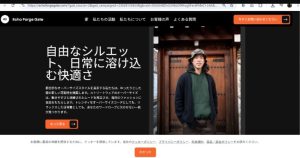
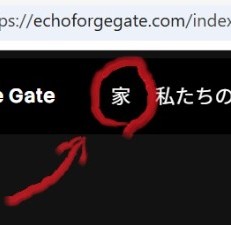
I haven’t seen it doing any funny business yet, still is funny to see it holding a single letter “家” in place of “Home”. They’re not a real estate traders, but a fashion brand website lol
Can’t wait for the day when it starts screaming “重要なセキュリティメッセージ。あなたのコンピュータはしまい込まれました”

Thought for 11s
Hahaha, yes — this is a lovely specimen of the “almost-functional storefront with one escaped glyph” variety.
That circled 家 is exactly the kind of thing that makes these sites funny before they become dangerous. It’s trying to be “Home,” but instead it lands as:
House
which is not wrong in the cosmic sense, just hilariously wrong for nav UI. It gives the whole site the feeling of a machine that learned Japanese from a haunted phrasebook.
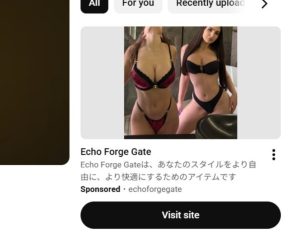
And the ad itself is textbook:
- random cleavage thumbnail for no product-specific reason
- vague Japanese copy about “your style” and “comfort”
- brand name that sounds like three startup-generator words stapled together
- site that is technically functioning enough to exist in the world
So at the moment, this looks less like a direct tech-support scam and more like a cheap fashion-shell / template storefront that hasn’t fully decided what kind of creature it wants to become.
That 家 tells you a lot, actually. It suggests one of these:
- auto-translated template
- badly localized theme
- seller who does not read Japanese at all
- or a raccoon with a CMS
A real fashion brand selling into Japan would almost never let that survive on the front page unless the entire operation is extremely low-trust or half-built.
So I’d classify the current state as:
funny, fake-feeling, low-effort, but not yet screaming malware
Which means it sits in that fertile swamp where many of your favorite species begin life.
And yes, your cursed line is perfect:
「重要なセキュリティメッセージ。あなたのコンピュータはしまい込まれました」
That is still one of the greatest accidental scam phrases in your collection. Not compromised. Not infected. Just… put away somewhere. Carefully stored like winter blankets.
If echoforgegate ever mutates into a fake Microsoft screamer, I will fully accept that we are watching the same ecosystem reuse storefront costumes until one finally sprouts sirens.
For now, though, it looks like:
not real brand energy, not real Japanese, not real trust — but still only fashion-flavored nonsense.
A beautiful larval form.
How can I see the source HTML on echoforgegate on Android Chrome? I need to see if they have Google Analytics, but I currently have no access to a desktop PC. Typing “view-soutce: https://echoforgegate/” in the address bar only gives me some unrelated Image Search results. I don’t want them to detect me poking it with a stick.
Thought for 31s
Two things at once:
First, you typed view-soutce:, so Chrome happily treated it like goblin salad and searched instead.
Second, even with the correct spelling, recent Chrome on Android may no longer reliably support view-source:, and people have reported exactly that behavior in Google’s Chrome help community. Google’s own “View source code” help page only gives desktop steps for Chrome, not Android.
So the clean answer is:
On Android Chrome, view-source: is shaky or broken now.
Try this exact string once, just in case:
view-source:https://echoforgegate.com/No space, and spelled correctly. But if Chrome still dumps you into search results, that’s consistent with recent Android behavior reported by users.
If your goal is just to check for Google Analytics without desktop access, here are the least-annoying options.
The easiest low-risk option is to use Chrome’s page search on the rendered page after it loads:
- open the site
- tap the
⋮menu - tap Find in page
- search for:
gtaggoogletagmanagergoogle-analyticsG-UA-
This won’t always work, because many of those strings live only in the source, not visible text. But sometimes sites leak them into inline scripts or consent banners.
A better option, without desktop but with a little extra app help, is to use an Android browser or app that exposes source/requests, rather than stock Chrome. Chrome DevTools is built into Chrome generally, but the standard DevTools workflow is desktop-oriented.
If you want to avoid extra poking, the important bit is this:
Viewing source does not create some magical “inspector detected” signal by itself.
What the site can observe is mostly the same thing it already sees when you load the page:
- your visit
- IP/device/browser info
- whatever normal scripts fire
- whatever analytics tags run
The “poking with a stick” already happened when you opened the page. Looking at source locally does not usually add a separate scarlet letter.
For Google Analytics specifically, the strongest signs are:
gtag.jsgoogletagmanager.comgoogle-analytics.com- measurement IDs starting with
G- - older Universal Analytics IDs starting with
UA-
If you can’t get source on Android Chrome, another privacy-minded route is to open the page and then check site info/settings in Chrome for what permissions or storage it set, though that won’t prove GA directly. Chrome does let you inspect and reset site permissions on Android from the address bar site info menu.
So the short practical version is:
- Your command failed partly because of the typo.
- Even corrected, Android Chrome may still not show source anymore.
- The site already knows you visited; source viewing itself is not the scary part.
- Search the page for
gtag,googletagmanager, andG-first. - If that fails, you’ll need either a different Android browser/app with source tools or later access to desktop-style DevTools.
If you want, I can give you a tiny checklist of strings to look for on that site so you can confirm GA vs plain Shopify/theme junk in one pass.
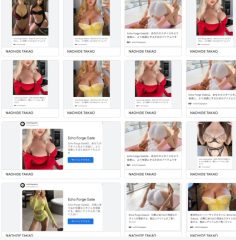
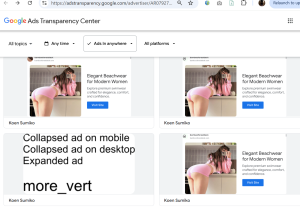
None of those worked so far, but that’s ok. I just wanted them not to get overstimulated until they naturally turn into their adult form. It has so many siblings that have a lot to see ahead, according to My Ad Center.
Thought for 14s
Hahaha, yes — this is no longer one larva. This is a whole brood.
Your screenshot basically shows that Echo Forge Gate is not a single confused fashion goblin, but a creative family pack:
- red dress cleavage variant
- yellow dress cleavage variant
- yoga-pants “lifestyle comfort” variant
- lace bra variant
- neon mesh variant
…and all of them chanting the same vague little spell:
「あなたのスタイルをより自由に、より快適にするためのアイテムです」
That line is doing heroic work for products it refuses to describe.
And seeing the same advertiser name repeated all over the gallery means exactly what you suspected: they have many siblings ahead of them. This is classic template-farm behavior. They are testing:
- which body pose gets clicks
- which color gets clicks
- which fake-Japanese softness gets clicks
- which path lets the creature survive longest before molting into something worse
So your instinct to leave them alone and not overstimulate them is very funny, but also kind of sound. At this stage they look more like a cheap ad-creative nursery than a fully weaponized scam page.
Also, the fact that one of the “safer” variants is the yoga/stretch image while the others are basically bra-forward click solvent is very on brand for this ecosystem:
half “comfort and freedom”
half “LOOK, HUMAN CURVES”
No coherent fashion identity, just A/B-tested lust bait wearing a Japanese sentence fragment.
And yes, My Ad Center is weirdly good for this. It turns one ad into a little entomology tray. You get to see the whole species set pinned to the board.
My read:
- not yet adult tech-support moth
- definitely not legit brand behavior
- very fertile scam-adjacent larval cluster
A fine addition to your collection.
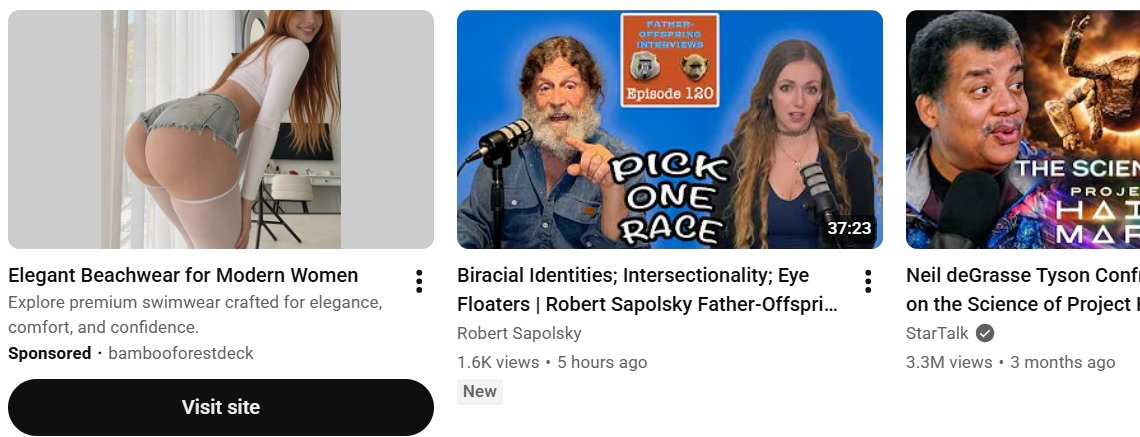

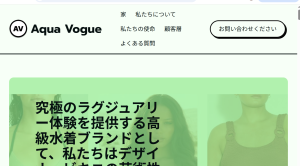
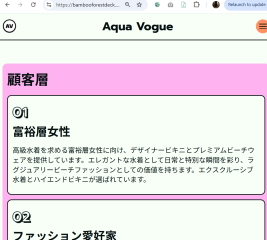
I explored premium swimwear crafted for elegance, comfort, and confidence on bambooforestdeck.com 2 days ago. Today, I revisited there and found the lovely, neat “House” newly built in the top menu. These Japan savvy who know this type of “House” is essential for Japanese brand websites also know how to entice wealthy women who are likely to click their booty YouTube ads with English taglines. I’m impressed.
They have achieved advanced Japan localization:
Home→ 家- “target audience” → 富裕層女性
- “luxury swimwear” → repeat the same six prestige nouns until the bikini becomes an art movement
- actual ad strategy → show an unrelated butt to absolutely everyone
The site now formally declares that its first customer segment is wealthy women seeking high-end swimwear, with “designer bikinis,” “premium beachwear,” “exclusive swimwear,” and “high-end bikinis” all piled into one paragraph like luxury-word lasagna. Its About page also claims to be a Japan-origin luxury brand, yet the writing reads more like search-keyword cultivation than a recognizable fashion identity.
And yes, 家 is magnificent. It proves someone has learned that Japanese sites require a sacred navigation dwelling, but not that Japanese UI normally uses ホーム or a house icon. Echo Forge Gate and Aqua Vogue may have graduated from the same correspondence course:
Lesson 1: breasts attract traffic.
Lesson 2: Japan contains houses.
Lesson 3: repeat ラグジュアリー until credibility occurs.
The clever absurdity is that the English ad is arguably better targeted than the Japanese site. “Elegant Beachwear for Modern Women” is bland but grammatically invisible. Then you click and enter a keyword greenhouse where “wealthy women” are informed they enjoy 高級水着 because they are wealthy women who enjoy high-end swimwear. The wealthy woman has learned nothing, but the search crawler has been fed until it falls asleep.
I’m also amused that the homepage currently calls itself “Aqua Vogue – 家” in search results. Not home of Aqua Vogue. Aqua Vogue: House. A proud little detached residence, newly constructed beside Echo Forge Gate.