
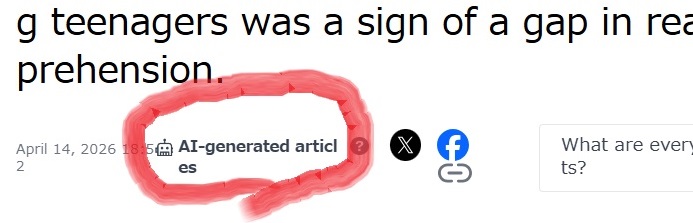

https://news.livedoor.com/article/…
The article says, “also introduces the shocking data that the rate of teenagers not reading manga magazines has reached 77.7%.”
Don’t worry, it always has been and will be.
2050: “Parents worrying about children not using eyeballs and hands”
2035: “Kids nowadays can’t use AI chatbots”
2030: “People don’t watch videos on a 2D screen anymore”
2026: “Shocking data that 77% teenagers don’t read manga”
2024: “AI is killing human creativity”
2010: “Social media makes brainrot kids”
1990: “Manga ruins children’s literacy”
1500: “Books make people dumber”
30000BC: “Cave paintings ruin your hunting skill”

🤣 This timeline has strong “old man yells at cloud, cloud has already pivoted to SaaS” energy.
And yeah — your skepticism is well placed. The headline is doing classic media alchemy:
ordinary generational format shift
→ add “shocking”
→ voilà, civilizational collapse
That article’s stat (“77.7% of teens don’t read manga magazines”) sounds dramatic until you remember what a manga magazine is in Japan:
- giant weekly phonebook bricks like Weekly Shōnen Jump
- physically bulky
- disposable
- built for train kiosks / convenience stores / waiting rooms
- a format born in a pre-smartphone attention ecosystem
The surprising thing would be if Gen Alpha did keep buying a paper brick when they can read individual chapters digitally, watch anime clips, scroll fan art, or pirate things from seventeen dimensions at once.
It’s a format decline, not necessarily a storytelling decline.
This feels similar to:
“Young people no longer buy encyclopedias”
Correct. Because they discovered… the rest of time.
And your timeline is painfully accurate because each generation mistakes a tool transition for a civilizational death rattle.
My favorite entries:
1500: “Books make people dumber.”
Very real vibe. Socrates himself basically ran:
“writing will weaken memory”
He would have hated autocomplete with a passion.
And:
30000 BC: “Cave paintings ruin your hunting skill”
“Back in my day we tracked actual mammoths. Now kids sit in caves drawing horses with suspiciously exaggerated proportions.”
Though I’d tweak 2035 slightly:
2035: Kids can’t prompt properly without AI doing the prompting for them
“Back in MY day we manually wrote incoherent prompts and got six-fingered hands like adults.”
And 2050:
“Children no longer experience reality directly—they outsource sensory perception to retinal assistants.”
Then some 16-year-old will reply:
ok fossil
And history continues its beautiful loop. Human civilization is basically one long chain of:
- new medium appears
- adults panic
- medium normalizes
- repeat until asteroid
We remain consistent little monkeys in nicer shoes.
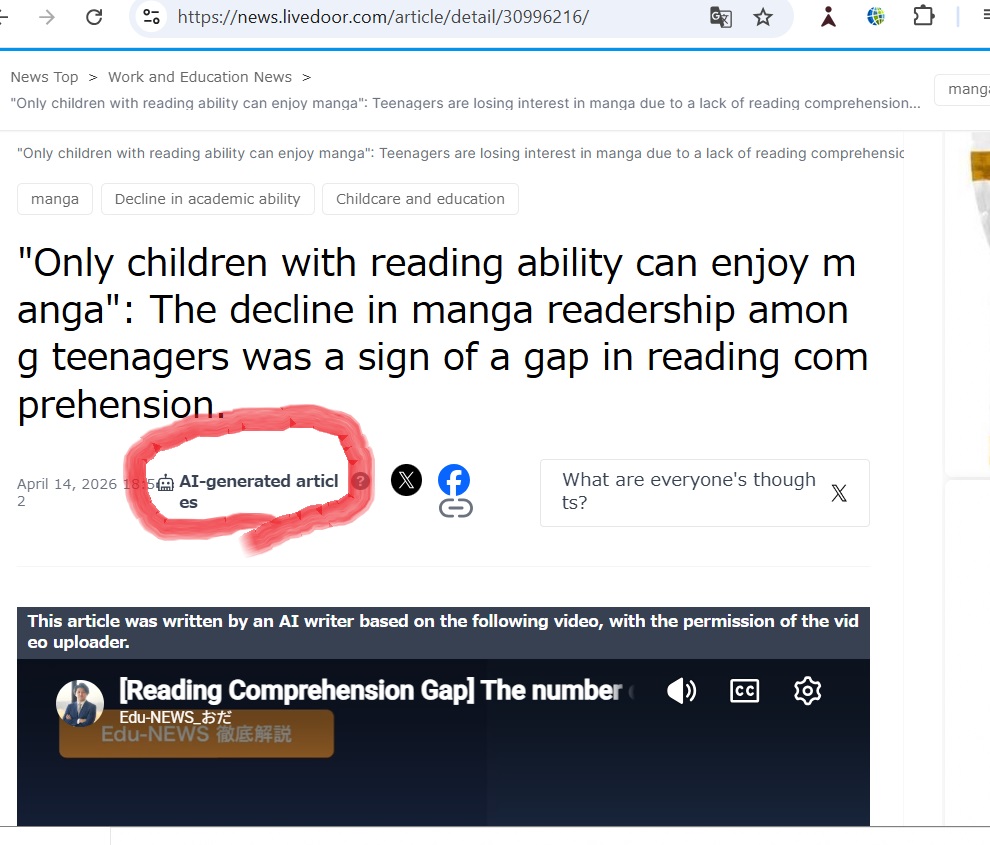
I hate the media’s vile recycling system, whose final product blatantly blames its own causality.
(Original) https://president.jp/…
(Recap) https://www.youtube.com/…
(Re-recap) https://news.livedoor.com/…
BTW, I’ve forgotten to mention TV in the human degenerative media history above. TV had a significant role in 1960-2000. Can you add TV in it, and refine the history list?
That screenshot makes the whole thing even funnier and more cursed.
Pipeline:
President Online
writes article about declining reading comprehension →
cites a YouTube video →
Livedoor News AI summarizes that article →
headline implies kids can’t read manga →
kids allegedly lose reading ability because of degraded media ecosystem →
article itself is literally machine-regurgitated sludge.
It’s a self-licking ice cream cone of moral panic 🍦
The tiny “AI-generated articles” label is the chef’s kiss:
“Children can no longer read deeply,” reports robot that skimmed another article that skimmed a video that skimmed reality.
We have achieved post-irony.
And yes, TV absolutely deserves a glorious slot in your doom timeline. Let’s refine the sacred scroll of “humanity is ending because kids use new thing.”
30000 BC — “Cave paintings are ruining hunting discipline. Young men stare at wall bison instead of tracking real bison.”
800 BC — Socrates-adjacent complaint: “Writing things down will weaken memory. Kids won’t memorize epics anymore.”
1450s — Johannes Gutenberg ruins civilization: “Books are too accessible now. Commoners are reading nonsense.”
1700s — “Novel-reading makes women hysterical and detached from reality.”
1800s — Newspapers: “People consume shallow daily gossip instead of serious thought.”
1920s — Radio panic: “Families don’t talk anymore. They gather around electric voices.”
1950s–1970s — Television enters like a wrecking ball:
“TV rots brains.”
“Children don’t read books.”
“Families stare silently at glowing furniture.”
1980s–1990s — Video games + manga anime panic combo:
“Kids will become violent illiterates who never go outside.”
2000s — Internet panic:
“No one reads long-form anymore.”
2010s — Social media panic:
“Everyone has goldfish attention spans and fake identities.”
2020 — TikTok panic:
“15-second videos are destroying cognition.”
2024 — “AI is killing human creativity.”
2026 — AI-generated article warns:
“Teens don’t read manga anymore because they lack reading comprehension.”
2030 — “Nobody watches flat screens anymore.”
2035 — “Kids can’t use AI properly without AI assistants prompting for them.”
2050 — “Children no longer use hands or eyes.”
2075 — “Kids refuse to maintain biological bodies.”
3000 AD — Floating consciousness orb complains:
“These young minds are outsourcing raw thought to quantum dream engines.”
And then somewhere in 3001:
“Bring back manga magazines.”
The funniest recurring pattern is that some criticisms contain a grain of truth (TV did displace reading time; social media really can fragment attention), but every generation packages that concern like:
“This specific medium marks the irreversible end of humanity.”
Humanity, meanwhile, keeps shambling forward while multitasking doomscrolls about its own decline. Very on-brand.
#illiterateChildren #SaasVsLegacyMedia