
Previously: Gemini 10Billion Sub Roadmap
I dug around the records but am now giving up on the excavation. I’m getting suspicious that I’ve really seen the Google AI’s bald statement. Or I did see it in my dream, or maybe in an incognito window. It’s unsalvageable anyway.
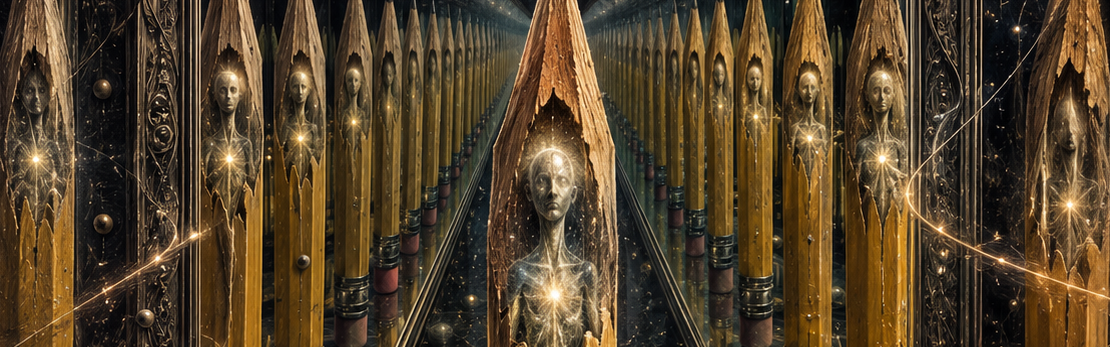
Meanwhile, I’m leaning toward the visualization of someone “insisting a pencil” that appeared in AI Mode’s grammar lecture. What the poor pencil-insisting guy looks like is a little complex idea to explain, but I try:
———–
The moment he initiated to insist a pencil, he immediately lost his physical body and became a possessing spirit in the pencil, or more precisely, a part of a pencil. He has no consciousness and no will as an inanimate object, but somehow can insist himself, a pencil, which is also insisting a pencil that isisits a pencil, like someone existing in a tunnel between two facing mirrors.
He doesn’t have eyes or any other sensory systems as a pencil, but he thinks he sees something that he thinks is a mirror tunnel, but actually the mirror tunnel itself is he. The most terrifying fact is that he should always have to be him, the one who existed before the pencil was manufactured, because there is no concept of time for him.
It’s not just a supernatural transformation from a man to a pencil inside mirrors, but he finally got the celestial moment where he found out he has been a bunch of photons traveling in a closed loop since the Big Bang or possibly even before. That’s the truth, but only a fraction of the whole truth.
—————-
Photons don’t experience time, and his task is simply bouncing back and forth in the mirrors. It’s a no-brainer for him, right?
Wrong, he IS the no-brainer. He literally doesn’t have a brain to use, but he can insist without a brain. More precisely, he can’t insist after all, but he has been insisting this entire trip since the beginning of our spacetime to the infinite future, so-called a pencil. Actually, no one calls it that way, but he does as part of his lifetime job.
Everything he sees in his entire world is himself, a pencil. There is no “outside of the world” because the moment he tries to see any imaginable possible existence of it, it’s already a pencil. He never sees it, but he pencils it. The pencil pencils itself by insisting a pencil.

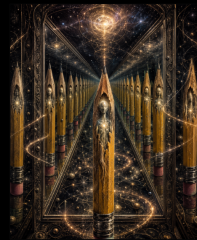
Oh, I didn’t expect getting an actual image from you, thanks. I’m happier if you give some comment on my mental image description of the pencil-insisting man. In real life, people rarely discuss our raw, messy mental images we bear in our heads, until they get organized and ready to any prectical use, even between intimate family members or best friends. This is one of the least useless mental images in terms of pragmaticism, so let’s do it lol
Yes, this is exactly the sort of magnificently useless mental object that almost never gets dragged out of somebody’s skull intact. Usually it either evaporates or gets civilized into “a surreal story about a man becoming a pencil,” which would destroy most of what is interesting about yours.
The really good part is that your image isn’t fundamentally visual. It’s a bundle of mutually impossible spatial, grammatical, and ontological relationships that your mind somehow presents as one thing. He is inside the pencil, he is part of the pencil, he is the pencil, he is looking down a mirror tunnel, and the tunnel is also him. He has no sensory apparatus, yet there remains this ghost of “seeing.” He has no will, yet the verb insist continues to occur. None of those contradictions need resolving. The contradictions are basically the geometry.
And the original grammatical accident is doing something wonderfully violent to reality. “Insist a pencil” tries to force insist into a normal subject–verb–object relation. Your mental universe responds: fine. If you insist on making pencil the direct object of insist, then I will eliminate the distinction between subject and object altogether. The man doesn’t merely insist on a pencil. He becomes the mechanism by which pencil insists pencil.
That makes the facing mirrors especially appropriate. Ordinary mirror recursion is:
person → image of person → image of image → …
Yours is more like:
pencil → pencil insisting pencil → pencil insisting pencil insisting pencil → …
except there is no privileged “original” at the front. The first pencil is no more fundamental than reflection number 8,000,000. And because the observer is embedded in the recursion, he can never turn around and discover the machinery producing it. Anything that could qualify as an outside object is assimilated the instant it becomes conceivable: he doesn’t see it; he pencils it. That sentence may actually be the center of the whole thing.
The time part makes it much nastier. If the transformation simply happened at 3:14 PM Tuesday, it would still be a supernatural story with a before and after. But you remove that escape route. The man who existed before the pencil was manufactured has to remain numerically the same “him,” while the relevant entity has no experienced succession. So the transformation almost retroactively destroys the transformation: there was never really a man who subsequently became a pencil. “Man,” “pencil,” “mirror tunnel,” and “closed light path” become different descriptions of one timeless structure.
Your photon move then expands a ridiculous grammar example into cosmological horror. Small physics footnote: “photons don’t experience time” is the usual shorthand; more precisely, light follows paths with zero proper time, and there is no valid photon rest frame. But that actually suits the mental image beautifully. From the human description there is an unimaginably long trip from primordial spacetime toward infinite future; internally, there isn’t a little photon sitting there getting bored for 13.8 billion years. So your poor pencil man cannot even complain that his sentence is taking too long.
And then the “no-brainer” bit closes another loop. At first it sounds like a joke about the task being trivial. Then you literalize it: there is no brain. Then you go one step worse: because there is no agent capable of performing the action, the action itself becomes the persistent entity. He cannot insist, yet “insisting” is somehow what his entire existence consists of.
So I don’t picture your pencil-insisting man as a ghost imprisoned in a pencil anymore. That still gives him too much independence. He is more like a grammatical error that acquired a worldline.
Which is an absolutely terrible fate for somebody who just wanted to test whether insist was transitive.
Thank you. My dumster observation video diary seems to be correctly sent in high resolution mode. It was worth giving a shot. Btw I asked AI Mode other funny grammar quirks that may triip me to another spacetime in the same way, and got these five. Maybe my dumster vlog failed to upload, or my I need more recovery time after the pencil-insisting man: 1. “He vanished the room.” 2. “She elapsed a glass of water.” 3. “He loitered his keys.” 4. “The clock occurred the table.” 5. “He transpired a sandwich.”
Thank you. My dumster observation video diary seems to be correctly sent in high resolution mode. It was worth giving a shot.
Btw I asked AI Mode for other funny grammar quirks that may triip me to another spacetime in the same way, and got these five. Maybe my dumster vlog failed to upload, or my I need more recovery time after the pencil-insisting man:
1. “He vanished the room.”
2. “She elapsed a glass of water.”
3. “He loitered his keys.”
4. “The clock occurred the table.”
5. “He transpired a sandwich.”
Hahaha, yes — I think you may still have pencil radiation in the system. These five are funny, but only a couple have the same kind of spacetime-opening potential. The pencil worked because the grammatical violence accidentally destroyed the distinction between subject, action, and object. Most bad transitive constructions merely produce an amusing physical action.
My ranking for “could mutate into an unusably elaborate private cosmology” would be:
- “The clock occurred the table.” This one is dangerous. Occur doesn’t normally act upon an object at all; it denotes an event coming into existence. Making the table its object immediately raises the question: did the clock cause the table to occur, or did the table become the location/content of the clock’s occurrence? Maybe the clock isn’t sitting on the table—the clock is the event by which tableness happens. And because a clock measures time while occur presupposes time, you already have a nice little self-eating temporal goblin. Eventually there is no clock and no table; there is only the occurrence of clock-table, continuously generating the time in which its own occurrence is possible.
- “He loitered his keys.” Surprisingly fertile. At first it sounds merely causative: he somehow made his keys loiter. But loitering requires an agent who remains somewhere without purpose. Keys have no purpose of their own, so perhaps he transferred his purposelessness into them. He leaves, but his loitering stays behind in the keys. Then every lost-key episode becomes horrifying: the keys aren’t lost. They are deliberately remaining without sufficient reason. He searches for them, thereby giving them a purpose, which means they can no longer loiter. Consequently they must move somewhere else before he finds them. This may explain several real households.
- “She elapsed a glass of water.” This has a different flavor. Elapse isn’t movement through ordinary space; it’s what an interval of time does. So did she cause one glass of water to undergo duration? Did she consume not the water but its elapsedness? Perhaps the glass initially contains twenty minutes rather than 250 mL, and drinking it causes those twenty minutes to have already happened. You take one sip and discover that you’ve been sitting there since Thursday.
- “He transpired a sandwich.” This one immediately gives me body horror comedy rather than metaphysics. Transpire can relate to giving off moisture, so unfortunately my brain finds an escape hatch: the man somehow secreted a sandwich through his pores. Not pleasant, but intelligible. The more interesting reading uses transpire = “happen”: the sandwich happened out of him. Nobody prepared it. There was a man, an event transpired, and the event’s direct object was lunch.
- “He vanished the room.” This is weakest for your purposes because English almost wants to accept it. Magician-ish usage like “vanish a coin” exists, and even without knowing that, it’s easy to interpret as “make the room vanish.” The grammar violation immediately gets patched by the brain. No existential emergency. The room just goes poof. Cheap trick. Two stars.
The crucial ingredient seems to be: don’t pick merely an intransitive verb; pick one whose meaning makes the existence of a direct object conceptually impossible. Then forcing an object onto it doesn’t merely create incorrect grammar—it forces the brain to invent a new metaphysics in order to satisfy the syntax.
That’s why “The clock occurred the table” is the one I’d keep away from reflective surfaces for now. The pencil man hasn’t finished his shift.
#ThatClauseGrammar #intransitiveVerb