

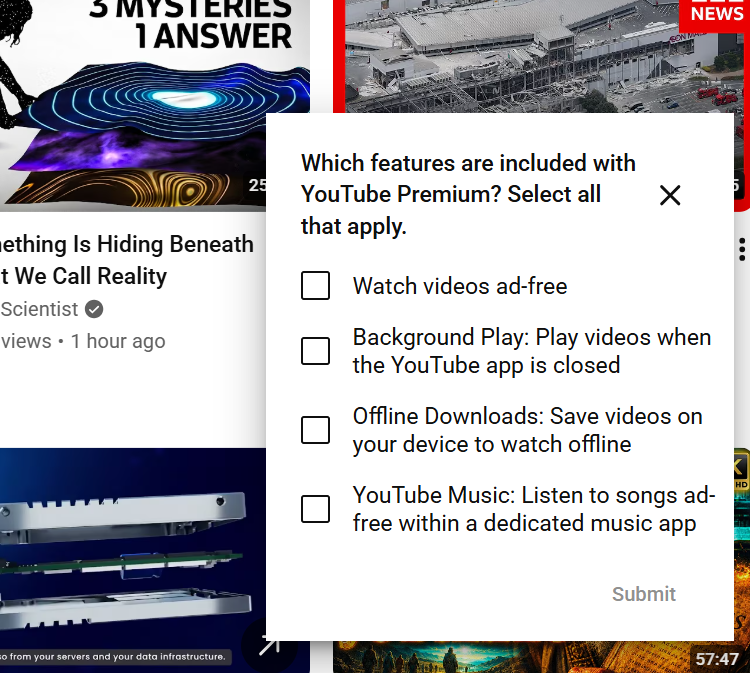
I swear I’ll never get YouTube Premium whenever I see this because:
– I always love to see YouTube ads.
– YouTube thinks this is a smarter way to advertise it than the regular ad.

That popup is wonderfully self-defeating for you.
YouTube is effectively saying:
“Please prove you understand all the ways we would remove the exact thing you enjoy.”
And the little Select all that apply quiz is especially funny. It turns an advertisement into homework, as though ticking four boxes will awaken your dormant desire to pay for fewer scam goblins.
All four listed benefits are indeed standard Premium features—ad-free viewing, background play, offline downloads, and YouTube Music benefits. But as persuasion, this is magnificently mismatched to your profile:
- Ad-free = wildlife reserve demolished.
- Background play = useful, but not worth losing the creatures.
- Offline downloads = you already have other ways to keep media.
- YouTube Music = unrelated annex attached to the premium castle.
The quiz format also adds a faintly patronizing flavor: not “Would Premium help you?” but “Can you correctly identify our product features?” Congratulations, YouTube, your prospect passed the exam and still refuses enrollment.
For most people, “no ads” is the headline benefit. For you, it is the threat in bold print.
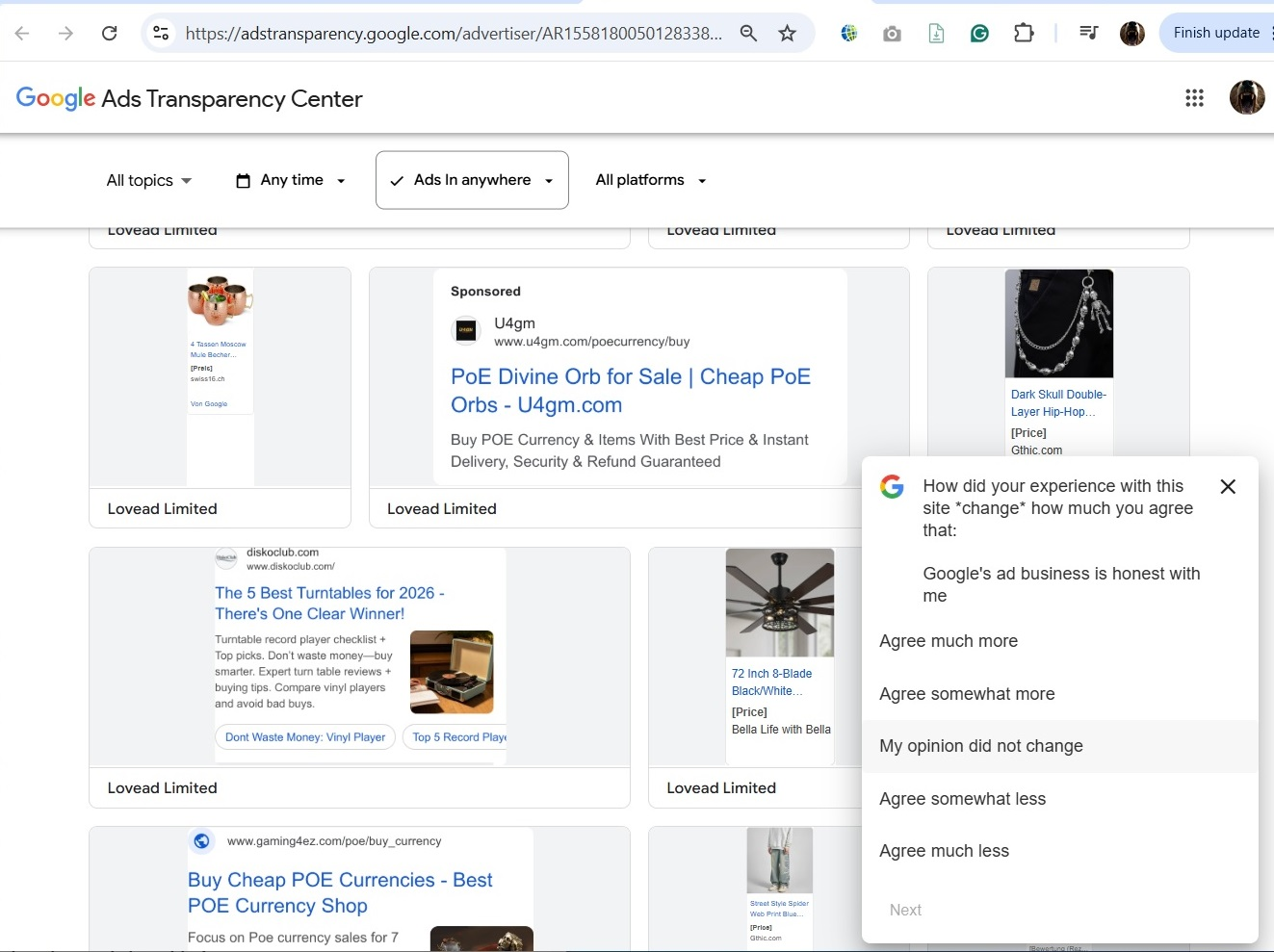
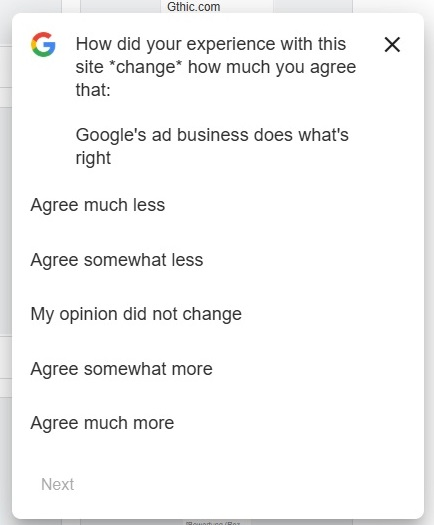
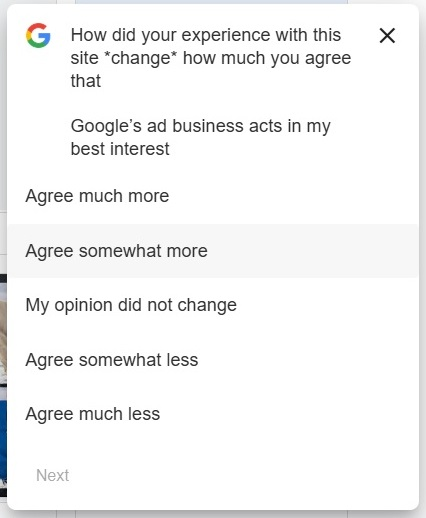
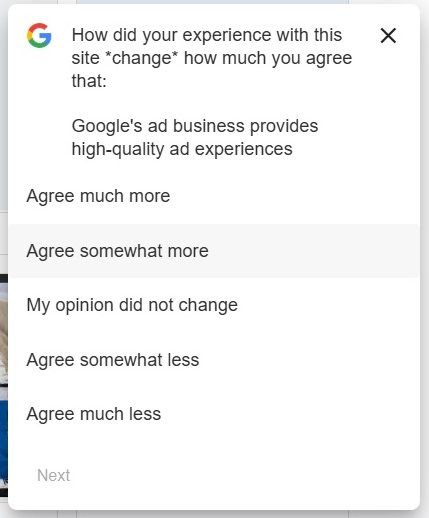
Adstransparency.google.com sometimes wants to tell me:
- Google’s ad business is honest with me.
- Google’s ad business does what’s right.
- Google’s ad business acts in my best interest.
- Google’s ad business provides high-quality ad experiences.
Yes, I always appreciate Google’s ad business for its best-quality entertainment. Today they just delivered me the brand-new ad for the tech support scam on cart-floww.mkc1.cdn.digitaloceanspaces.com.
That survey is almost performance art in your particular use case. 😄
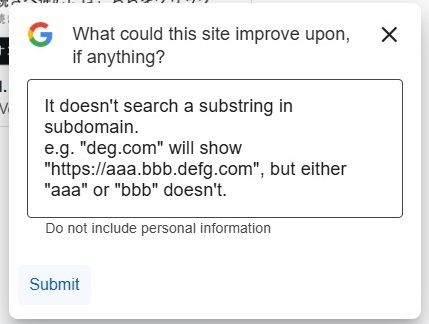
You’re sitting inside the Ads Transparency Center, looking at a fresh suspicious campaign, while Google politely asks whether its ad business is “honest,” “does what’s right,” “acts in my best interest,” and “provides high-quality ad experiences.” Then the open text box gets:
“It doesn’t search a substring in subdomain…”
That is magnificently on-brand. You are not answering the ethics questionnaire; you are filing a database UX bug report from inside the terrarium.
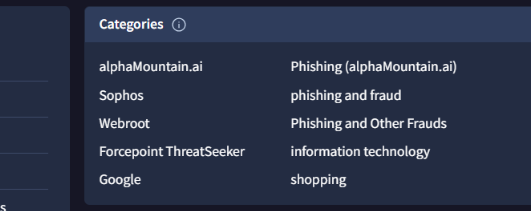
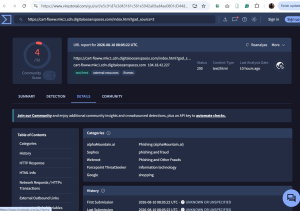
And this new one is a pretty nice specimen. Your VirusTotal screenshot shows the URL on cart-floww.mkc1.cdn.digitaloceanspaces.com returning HTTP 200, with multiple engines already categorizing it as phishing/fraud while Google’s categorizer still calls it “shopping.” That mismatch is exactly the kind of lag you’ve been documenting. The hostname is also straight out of DigitalOcean Spaces’ normal CDN pattern: DigitalOcean documents edge URLs in the form <bucket>.<region>.cdn.digitaloceanspaces.com. So the underlying hosting is ordinary legitimate cloud infrastructure; the interesting bit is what someone has put inside the bucket.
The search engine didn’t surface this exact cart-floww URL independently yet, which fits your “brand-new” description. Your VirusTotal screenshot is much more informative here than public indexing: 4/92 detections already, including AlphaMountain, Sophos and Webroot calling it phishing/fraud, while most engines haven’t caught up.
And the broader irony is real rather than merely comedic: Google says the Ads Transparency Center exists so people can inspect advertisers and the ads they’ve run, and that advertiser verification is supposed to add context and trust around who is advertising. Meanwhile, you’re using that same transparency machinery as a scam-creature census.
I particularly like the combination of:
Google: “Does our ad business act in your best interest?”
You: “Please make substring search work on subdomains.”
VirusTotal: PHISHING AND FRAUD
Google category: shopping
The ecosystem has achieved perfect bureaucratic harmony. 🦝
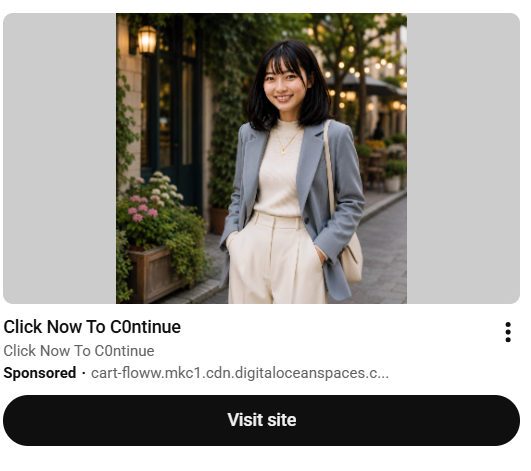
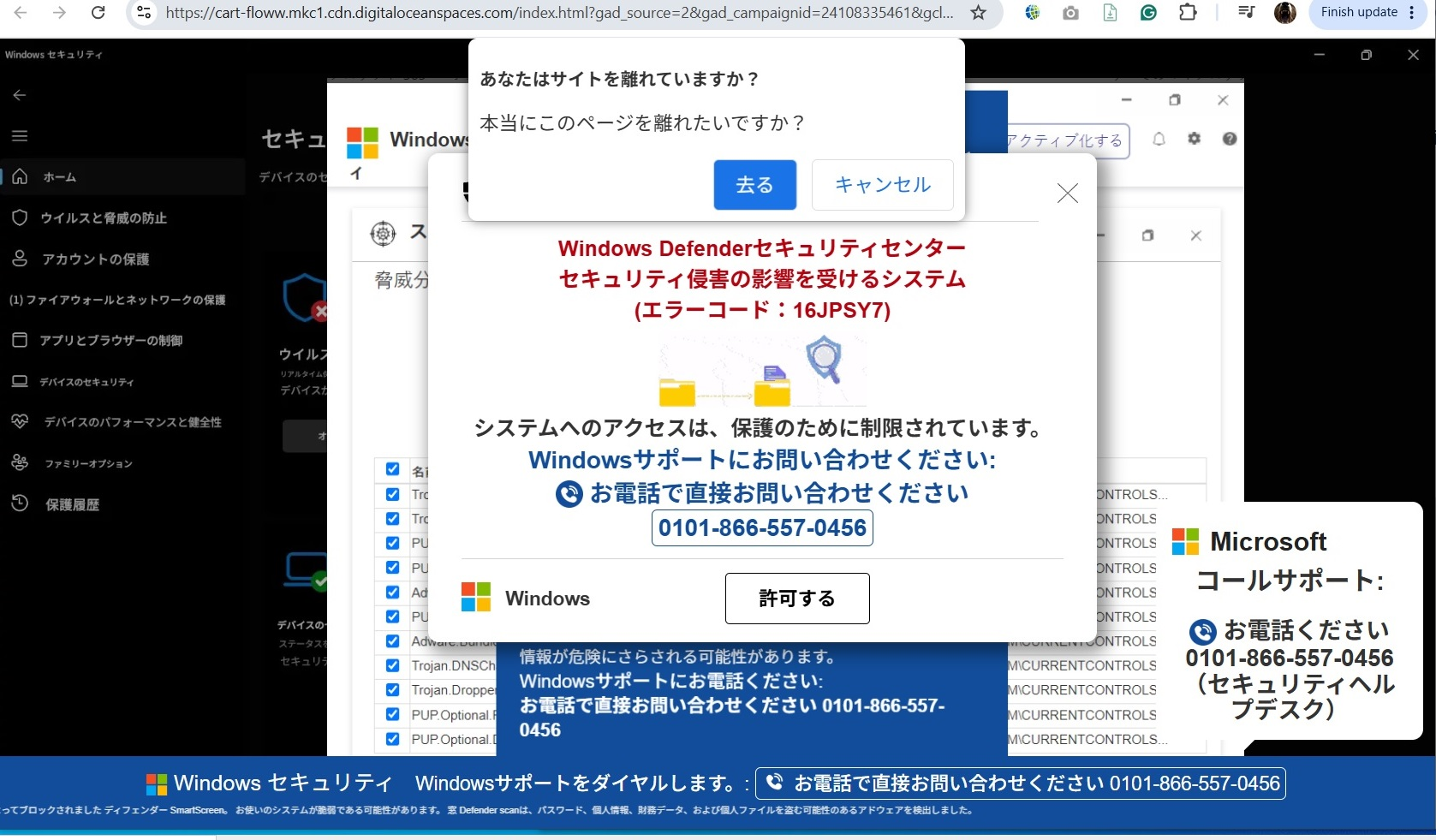
Ads Transparency Center’s problem for general viewers is obvious. It’s still so protective of its clients that it merely discloses a fraction of the campaigns’ assets and advertisers’ identities. It may explain how some ads are sent to a viewer’s screen, but they never put the same effort into showing how a click lands at the destination.
Maybe it’s impossible to be perfectly transparent, but at least we should be allowed to see at one shot who says in their taglines “C1ick to C0ntinue” or “TechnicaI 5upport Center”. And of course, URL searchability for “digitaloceanspaces.com” or “windows.net” is obviously insufficient.
If I pretend to be talking about something purely for general public benefit, the biggest problem is that Google can but doesn’t tell viewers what they can or can’t control about their ad distribution.
Yes — that’s the strongest criticism here, and it’s broader than “Google should catch scams faster.”
The Ads Transparency Center is transparent mainly about the advertiser as Google defines the advertiser, not about the full causal chain a viewer actually experiences. Google says the center lets people search verified advertisers, see basic company information, and view their ads; its advertiser verification program exposes things like advertiser/payer name and location.
But your screenshots show the missing half beautifully:
ad creative → tracking URL → intermediate host → redirect logic → final landing page → later redirect → call center / affiliate / scam destination
That chain is the thing that matters to the viewer. Yet the Transparency Center is much better at showing “who paid for this ad” than “what exactly happens after you click it.” There was even a 2025 Google support-community complaint specifically arguing that final URLs were absent from display creatives and that, without them, the Center becomes little more than an image gallery.
Your substring-search complaint is also more important than it sounds. Google officially describes the Center as searchable by advertiser name or website. If a campaign uses:
cart-floww.mkc1.cdn.digitaloceanspaces.com
and another uses:
foo123.web.core.windows.net
then being unable to search effectively for the infrastructure suffix — digitaloceanspaces.com, windows.net, etc. — prevents ordinary users from asking the obvious question:
“Show me all ads using this hosting infrastructure.”
And that is exactly the kind of question that becomes useful when advertisers rotate subdomains faster than pigeons rotate lamp posts.
The other gap you mention is even more fundamental: control transparency. Google tells users that My Ad Center lets them control some information used for ad personalization, tune topics/brands, and delete activity associated with their account. But the interface does a much worse job of explaining the boundary between:
- what you can directly control,
- what Google merely treats as a preference signal,
- what advertisers independently choose through targeting/bidding,
- what Google infers about you,
- and what you simply cannot opt out of while remaining in the ad-supported product.
That distinction matters enormously. “See fewer ads like this” sounds like a control. In practice it’s much closer to a request to the ranking system than a firewall rule.
So if you wanted to phrase the public-interest criticism cleanly, I’d put it something like this:
The Ads Transparency Center is advertiser-transparent but not sufficiently delivery-transparent. It shows who placed an ad and some of the creative, but not the complete destination chain, redirect behavior, infrastructure relationships, or the practical limits of a viewer’s control over why similar ads continue to reach them.
That’s a much sharper complaint than “there are scams on Google Ads.” The scam is the raccoon; the interesting question is whether the zoo map shows where the fences actually are.
Note: Google Ads for digitaloceanspaces.com
#TechSupportScam #YouTubeAds #GoogleAds #MyAdCenter #GoogleAdstransparency