

Can I safely say this sentence is grammatically incorrect?
“You may have some chance if it is to be effectively suppressed.”

No, you cannot safely say this sentence is grammatically incorrect.
While the sentence “You may have some chance if it is to be effectively suppressed” feels unnatural and awkward to a native speaker, it does not violate any strict rules of English grammar. [1]
Why It Is Grammatically Correct
- Structure: It follows a standard conditional structure (if + present passive infinitive).
- “Is to be”: The phrase “is to be” is a valid grammatical construction used to express a requirement, a future plan, or a precondition (e.g., “If you are to succeed, you must work hard”).
- Meaning: Grammatically, it translates to: “You might have a chance, provided that ‘it’ is required/destined to be stopped effectively.”
Why It Feels Wrong (Stylistic Issues)
The issue with the sentence is style and idiom, not grammar. It suffers from three main problems: [1]
- Vague Pronoun: The word “it” has no clear antecedent. We do not know what is being suppressed.
- Collocation Clash: The phrase “have some chance” sounds weak when paired with a strong, clinical word like “effectively suppressed.”
- Wordiness: The “if it is to be” construction creates unnecessary distance and passivity.
Better Alternatives
To make the sentence sound natural while keeping the original intent, rewrite it based on what “it” refers to:
- If “it” is a disease or rumor: “You may stand a chance if we effectively suppress it.”
- If “it” is an emotion or reaction: “You might have a chance if it is effectively contained.”
- A more natural conditional: “You have a chance only if it is suppressed effectively.”
Would you like to share the context or the full paragraph this sentence came from? I can help you rewrite it so it sounds natural and professional.
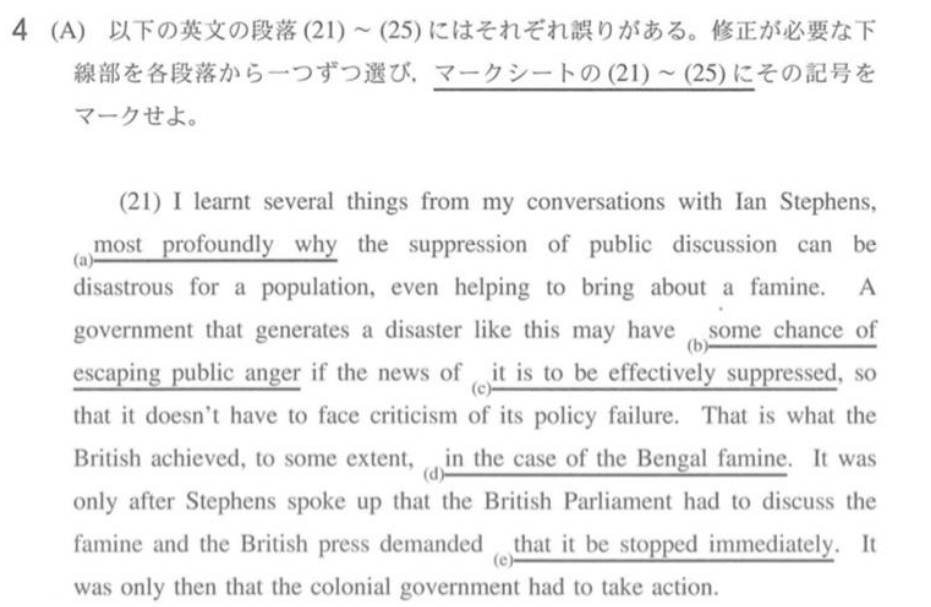
That sentence, “You may have…” was part of a University entrance exam in Japan (attached image). It was not the exact one, but I rearranged the sentence, removing minor details from the original one, “A government that…be effectively suppressed.”
They claim the correct answer to question(21) is (c), in which “to be” should be removed. Do you still support their “correct” answer?
Thank you for providing the full context from the exam paper. Seeing the full paragraph completely changes the situation, and the university’s answer key is absolutely correct.
While the isolated sentence you asked about before technically follows mechanical grammar rules, (c) is a major contextual and semantic error within this specific paragraph.
Here is exactly why “to be” must be removed and why the university’s answer is right.
The Problem: How “If + subject + be to” works
In English, when you use the structure “if… is/are to + verb”, it carries a very specific meaning: “in order to” or “if it is intended to.”
- Example: “If you are to pass the exam, you must study.” (Meaning: In order to pass the exam, you must study.)
Notice the cause-and-effect order in a correct “be to” conditional sentence:
- The ‘if’ clause is the ultimate goal/future result (passing the exam).
- The main clause is the prerequisite action needed to get there (studying).
Why it fails in the exam text
Let’s look at the logic of the exam text with “is to be” left in:
*”A government… may have a chance of escaping public anger [Goal] if the news of it is to be effectively suppressed [Prerequisite].” *
If we apply the “be to” rule here, the sentence is saying:
- “In order for the news to be suppressed, the government has a chance of escaping public anger.”
This completely flips the logic upside down. Escaping public anger does not cause the news to be suppressed. It is the exact opposite: suppressing the news is what allows them to escape anger.
The Correction: Standard First Conditional
By removing “to be”, the sentence becomes a standard present-tense conditional:
“…if the news of it is effectively suppressed…”
Now, the logic is perfectly correct:
- Condition: The news gets suppressed.
- Result: The government has a chance to escape public anger.
Summary
The university is testing your understanding of conditional logic and the specific semantic meaning of the “be to” infinitive. In isolation, “is to be” can exist grammatically, but in this paragraph, it creates a logical contradiction. Removing “to be” fixes the sentence perfectly.
If you are preparing for more questions like this, I can help you break down other confusing grammar rules tested in Japanese exams (like subjunctive mood or participle constructions). Which topic would you like to review next?
What about correcting (b) instead of (c), like this:
A government that generates a disaster like this may have further plans to reinforce censorship if the news of it is to be effectively suppressed, so that it doesn’t have to face criticism of its policy failure.
No, you cannot correct the text by changing section (b) instead of (c).
While your rewritten sentence is a creative and perfectly grammatical use of the “is to be” structure, it is incorrect in the context of an entrance exam for two definitive reasons:
1. You Cannot Redefine the Exam’s Instructions
On Japanese university entrance exams (like the Center Test, Common Test, or private university exams), error-recognition questions strictly require you to find the one grammatically or logically broken element that can be fixed with a minimal correction.
- The standard fix (c): Deleting just two words (“to be”) completely restores the author’s original meaning and fixes the grammar.
- Your fix (b): Rewriting “some chance of escaping public anger” into “further plans to reinforce censorship” is a complete rewriting of the text’s core ideas. You are changing the author’s message rather than fixing a mechanical error.
2. It Breaks the Context of the Rest of the Paragraph
Even if you changed (b) to your sentence, it would break the logical connection to the sentences that immediately follow it.
Look at the very next sentences in the text:
“…so that it doesn’t have to face criticism of its policy failure. That is what the British achieved, to some extent…”
- The original logic: The British government successfully escaped criticism during the Bengal famine by suppressing the news.
- Your new logic: If you change (b) to your version, the phrase “That is what the British achieved” would mean “The British successfully achieved further plans to reinforce censorship so they wouldn’t face criticism.” While historically true that they censored the media, the focus of this specific passage (which heavily mirrors the arguments of economist Amartya Sen on democracy and famines) is about how the absence of public criticism allows a government to get away with disasters.
By changing (b), you alter the historical and philosophical point the paragraph is trying to make.
Would you like to analyze any of the other options in this specific text (such as why (a), (d), or (e) are considered perfectly correct)?
AI can make mistakes, so double-check responses
🔗Continue(2): How to Defend the Professor (Ask AI Mode)
#ExamNitpicker #東京大学入学試験問題